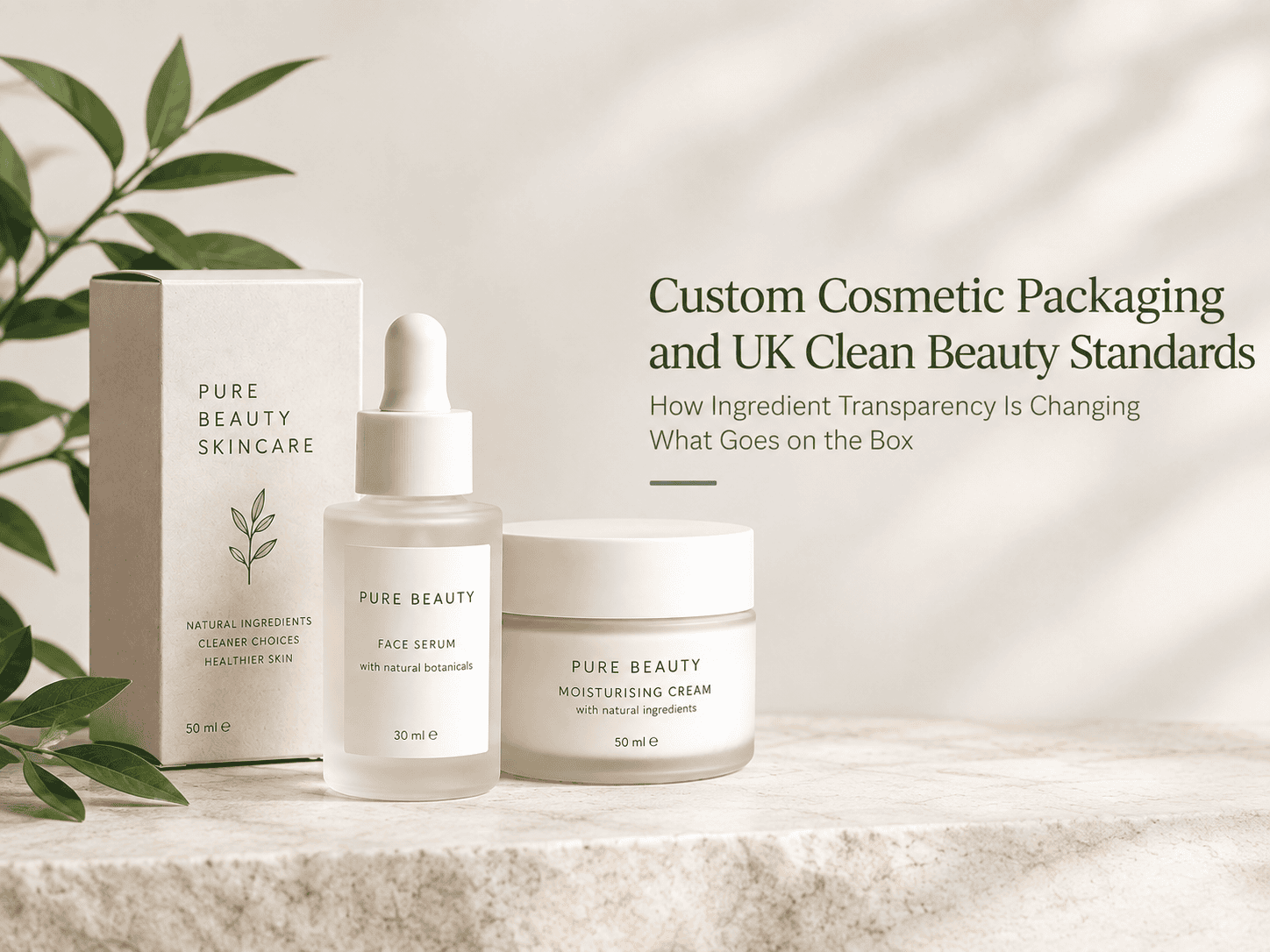
The clean beauty conversation in the United Kingdom has moved through several distinct phases since it first entered mainstream consumer consciousness, and the phase it currently occupies is commercially different from every previous one in a way that matters directly for what goes on custom cosmetic packaging. In the early phase, clean beauty was a marketing position that brands adopted through general language about natural ingredients and what their products didn’t contain. In the middle phase, consumer scepticism about vague clean claims began driving demand for more specific information, and the industry responded with a proliferation of certifications, ingredient glossaries, and transparency initiatives whose credibility varied enormously. In the current phase, a meaningful proportion of UK beauty consumers have developed sufficient ingredient literacy to evaluate packaging claims independently rather than accepting brand definitions of clean at face value, and this literacy shift has changed what packaging needs to communicate and how.
The commercial consequence of this literacy shift isn’t simply that brands need to be more careful about what they claim. It’s that the information architecture of custom cosmetic packaging, the hierarchy of what appears where, in what size, in what language, and with what level of supporting detail, needs to be rebuilt around what an ingredient-literate consumer is actually looking for rather than around what a marketing brief decided they should be told. These are different briefs producing different packaging, and the brands whose custom cosmetic packaging was developed in the earlier phases of the clean beauty conversation are increasingly finding that their packaging communicates less than it could to the consumers who are now their most commercially valuable audience.
What Has Changed in UK Consumer Ingredient Literacy
The ingredient literacy that UK clean beauty consumers have developed is more specific and more practically useful than the general awareness of ingredients as a quality signal that characterised the earlier clean beauty market. A UK consumer who could identify parabens as a category of concern five years ago is now, in a meaningful number of cases, capable of reading a full INCI ingredient declaration, identifying the position of specific ingredients relative to the one percent threshold below which ingredients appear in order of concentration, recognising the difference between fragrance as a single listed ingredient versus disclosed individual fragrance components, and assessing whether a brand’s clean claims are consistent with its actual ingredient list.
This practical literacy has been developed through a combination of sources that custom cosmetic packaging increasingly needs to serve rather than circumvent. Social media communities dedicated to ingredient education have grown substantially in the UK market, with accounts and communities devoted to ingredient transparency attracting followings in the hundreds of thousands. Ingredient analysis applications including INCI Decoder and CosDNA have moved from niche tools used by formulation enthusiasts into mainstream consumer reference resources whose usage reflects a broad audience rather than a specialist one. UK beauty journalism has shifted toward ingredient analysis as a primary content format in ways that have educated readers to apply the same analytical framework to packaging they encounter independently.
The practical consequence of this literacy development is that custom cosmetic packaging whose ingredient communication is limited to marketing claims about what the product doesn’t contain is communicating less information to a more capable audience than it was designed for. A box that says paraben-free and fragrance-free to a consumer who can read the INCI list and verify these claims directly is adding no information through these claims that the consumer couldn’t derive themselves. A box that helps the same consumer understand what the product does contain, and why those specific ingredients were chosen, is providing information that the INCI list alone doesn’t convey and that creates genuine communication value for a literate audience.
How Ingredient Transparency Is Changing Panel Architecture
The panel architecture of custom cosmetic packaging, the spatial organisation of mandatory labelling, brand communication, and supporting information across available panel surfaces, is being restructured by clean beauty ingredient transparency requirements in ways that affect specification decisions from the earliest stages of packaging development rather than at the artwork stage.
Mandatory INCI ingredient declarations on UK cosmetic packaging must appear in descending order of concentration above one percent, with ingredients below one percent appearing in any order after the one percent threshold. This mandatory content has a defined space requirement that scales with the number of ingredients and the minimum type size requirements that UK cosmetic regulation specifies. Products with complex multi-ingredient formulations whose transparency positioning requires full disclosure of every component have larger mandatory declaration space requirements than products with simplified formulations, and this space requirement competes with the surface area available for brand communication and supporting ingredient explanation content.
Clean beauty brands whose transparency positioning extends beyond the mandatory INCI declaration to include ingredient origin information, processing method disclosure, sustainability sourcing details, and ingredient function explanations have packaging copy requirements that may double or triple the panel space consumed by ingredient-related content. Packaging brief development for these brands needs to account for this expanded ingredient communication requirement in the structural specification stage rather than attempting to fit additional content onto panels whose dimensions were set without it, because the spatial consequences of full ingredient transparency are significant enough to affect structural decisions that can’t be changed at the artwork stage.
Key ingredient callouts on front panels, the practice of highlighting specific hero ingredients through visual prominence rather than burying them in the INCI declaration, have evolved from a general marketing technique into a specific transparency signal whose credibility depends on alignment with the full INCI declaration. A front panel that prominently features bakuchiol as a hero ingredient whose value is explicitly communicated to a literate consumer is providing useful directional information. The same front panel in packaging whose INCI list reveals bakuchiol appears in the lower third of ingredients at a concentration that limits its functional significance is creating a transparency contradiction that literate consumers identify and that undermines the brand’s clean credibility rather than building it.
What UK Clean Beauty Certifications Require From Packaging
The certification landscape that UK clean beauty brands navigate is more varied and less standardised than the marketing language around certifications suggests, and the packaging requirements that different certifications impose differ in ways that brands seeking multiple certifications don’t always anticipate before beginning packaging development.
The Soil Association’s COSMOS organic and natural certifications, which represent the most widely recognised third-party certification framework in the UK clean beauty market, impose specific labelling requirements including mandatory use of certification logos in defined sizes and formats, restrictions on claims that can appear in close proximity to the logo, and requirements around the percentage of organic ingredients that packaging copy must accurately reflect. Brands holding COSMOS certification who develop packaging without reference to these specific labelling requirements may find their artwork rejected by the certifying body or requiring revision that affects other panel elements whose positioning was set around the original artwork rather than the compliant revision.
The Leaping Bunny cruelty-free certification, whose UK recognition is higher than any alternative cruelty-free certification among the UK consumer base, requires logo usage according to specific guidelines that govern minimum logo size, required accompanying text, and colour reproduction parameters. Packaging that uses a cruelty-free logo whose appearance doesn’t meet Leaping Bunny’s logo usage specifications creates certification credibility problems that ingredient-literate consumers, who are among the most certification-aware shoppers in the UK beauty market, are equipped to identify through direct comparison with the official certification standards.
The B Corp certification that a growing number of UK clean beauty brands hold imposes its own visual identity requirements around how the B Corp logo appears on packaging, alongside the broader transparency expectations about business practices that B Corp certified brands communicate through packaging copy in ways that non-certified brands don’t. The combination of B Corp certification with cosmetic ingredient certifications creates a multi-certification packaging brief whose individual visual requirements need to be resolved into a coherent panel architecture rather than applied sequentially without reference to each other.
What Fragrance Disclosure Is Becoming in UK Clean Beauty Packaging
Fragrance disclosure represents the most commercially sensitive area of ingredient transparency in UK clean beauty packaging because it sits at the intersection of consumer demand for full ingredient disclosure and the intellectual property protection that fragrance formulations have traditionally relied on trade secret status to maintain.
UK cosmetic regulation, following the inherited EU framework, requires disclosure of twenty-six specific fragrance allergens above defined concentration thresholds in rinse-off and leave-on products. This mandatory allergen disclosure represents the regulatory minimum rather than the transparency standard that UK clean beauty consumers are increasingly expecting from brands whose clean positioning implies ingredient disclosure beyond regulatory minimum requirements.
The clean beauty transparency standard that UK consumers and the retail buyers at Holland and Barrett, Whole Foods UK, and independent clean beauty retailers are beginning to apply to fragrance is full disclosure of individual fragrance components rather than the single fragrance or parfum entry that regulatory compliance permits. Brands whose formulations use complex proprietary fragrance blends whose full disclosure would compromise intellectual property are navigating a genuine tension between transparency positioning and intellectual property protection that packaging brief development needs to address rather than defer.
Custom cosmetic packaging for UK clean beauty brands is increasingly including dedicated fragrance disclosure panels or inserts that provide the component-level fragrance information that interested consumers can reference without making this information the dominant packaging communication for consumers less interested in this level of detail. This disclosure architecture, providing full information accessibly rather than prominently, represents a transparency approach that serves the literate consumer without overwhelming the panel space of packaging whose primary communication needs to serve a broader audience simultaneously.
How Digital Integration Is Extending Packaging Ingredient Communication
The physical constraints of custom cosmetic packaging panel space create a ceiling on the depth of ingredient communication that can be provided on-pack, and UK clean beauty brands are increasingly using digital integration through QR codes to extend ingredient transparency beyond what physical packaging dimensions accommodate.
QR codes linking to full ingredient origin databases, formulation philosophy explanations, ingredient sustainability sourcing documentation, and third-party safety assessment summaries provide the depth of transparency that ingredient-literate UK consumers are seeking without requiring the panel space that equivalent on-pack content would consume. The commercial logic of this digital extension is straightforward: the consumers who will follow a QR code to a full ingredient disclosure page are the consumers whose purchasing decisions are most strongly influenced by ingredient transparency, making the digital content investment highly targeted to the audience whose conversion it most directly affects.
The QR code positioning and presentation on custom cosmetic packaging affects both its usage rate and its brand communication value. A QR code presented as a functional access point to deeper information, with copy that communicates what the consumer will find when they scan it, generates higher engagement than a QR code presented as a generic digital touchpoint without destination explanation. UK clean beauty consumers who are actively seeking ingredient information respond to packaging that acknowledges this seeking behaviour and directs it efficiently rather than leaving the QR code’s destination ambiguous.
The information that QR codes direct to needs to be genuinely useful to a literate audience rather than simply more extensive than what the packaging provides. A QR code destination that provides INCI names in a more readable format than the mandatory declaration without adding substantive information about ingredient function, origin, or selection rationale is providing additional quantity without additional quality, which the literate consumer it’s designed for will recognise and discount as a transparency performance rather than genuine transparency.
What Custom Cosmetic Packaging Briefs Need to Address for UK Clean Beauty
The packaging brief that produces custom cosmetic packaging genuinely suited to UK clean beauty transparency requirements needs to address questions at the structural, content, and communication architecture levels that conventional cosmetic packaging briefs don’t typically include.
At the structural level, the brief needs to quantify the panel space requirement for full ingredient communication including mandatory INCI declaration, certification logos with required surrounding space, hero ingredient callouts, fragrance disclosure provisions, and any digital integration elements. This panel space quantification, conducted before structural dimensions are set, allows the packaging structure to accommodate the full communication requirement rather than requiring content compression after dimensions are fixed.
At the content level, the brief needs to distinguish between content whose purpose is regulatory compliance, content whose purpose is brand transparency communication to literate consumers, and content whose purpose is category navigation for less ingredient-aware shoppers. These three content purposes require different copy approaches, different type specifications, and different panel positions whose hierarchy communicates which content serves which purpose rather than presenting all content at equivalent visual priority.
At the communication architecture level, the brief needs to establish how the physical packaging and its digital extension work together as a complete communication system rather than treating the QR code as an addition to the packaging rather than an integral part of it. The physical packaging sets the direction and invites the engagement. The digital destination fulfils the depth of transparency that direction promised. This system only works as intended when both elements are designed with reference to each other from the beginning of the packaging development process rather than the digital component being added to a packaging whose physical communication was developed without it.
Aly Packaging UK works with clean beauty brands developing custom cosmetic packaging that accommodates UK ingredient transparency requirements within a coherent panel architecture aligned with certification specifications. Contact our UK team at sales@alypackaging.com or call 1-844-259-7225 to discuss your cosmetic packaging brief before artwork development begins.