
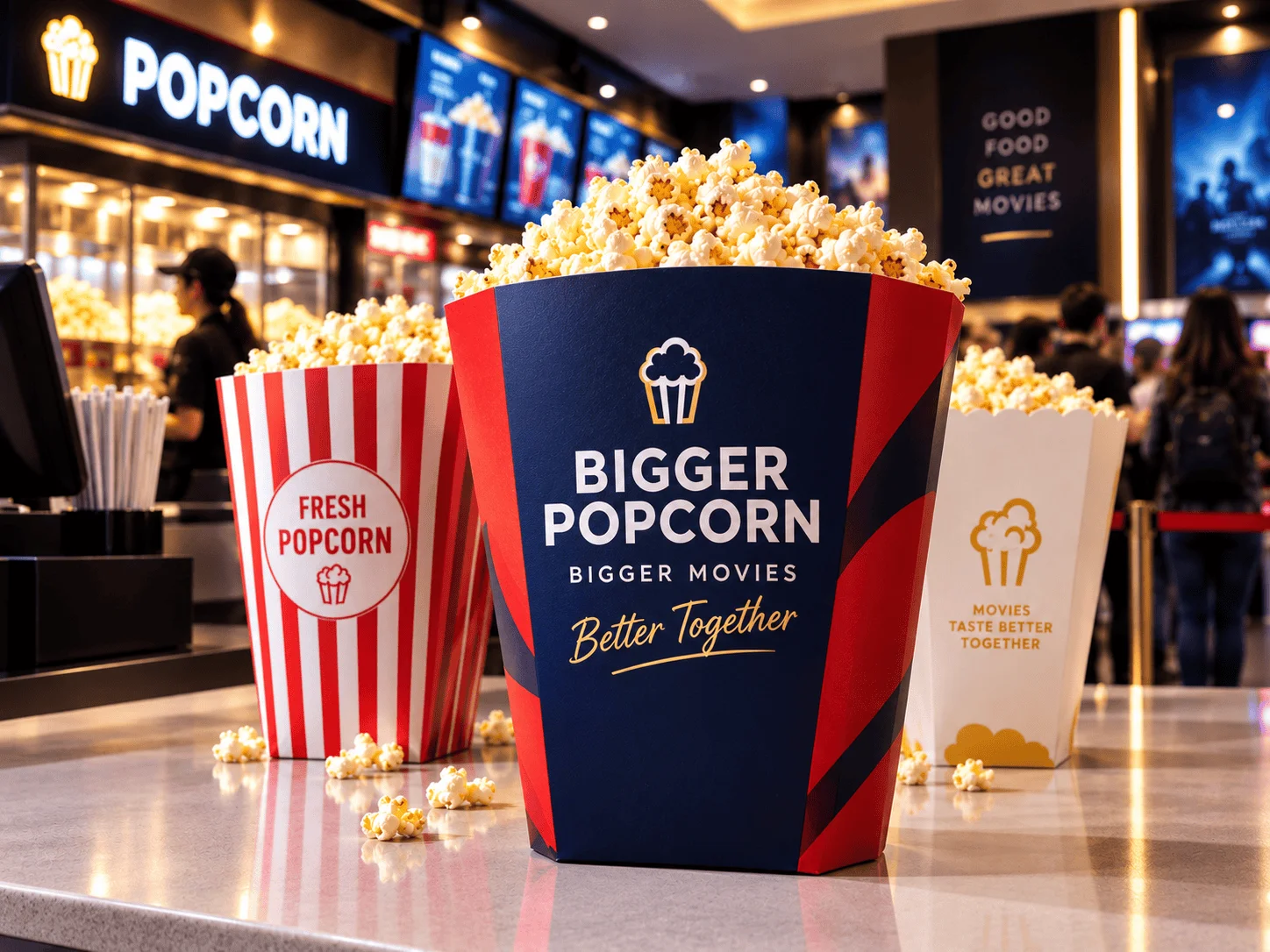
Cinema concession managers at UK multiplexes make hundreds of operational decisions every week that never appear in any packaging brief. They decide how to stack large popcorn boxes behind the counter during the pre-screening rush when thirty customers are queuing and two staff members are filling orders simultaneously. They decide where to store the boxes between deliveries and how many to bring out at once when the screen changeover window is twelve minutes and three screens are turning around simultaneously. They decide, without consciously framing it as a decision, how much force to apply when filling boxes at speed and whether to rest filled boxes against adjacent surfaces while the till transaction completes. None of these operational realities appear in the standard large popcorn box specification, and every one of them creates structural demands that standard packaging wasn’t built to survive.
UK multiplex cinema operations run on throughput velocity rather than individual transaction quality. The commercial model of Vue, Odeon, and Cineworld depends on moving the highest number of customers through the concession stand in the shortest time before each screening, because concession revenue is time-gated by the screening start time in a way that no other retail food environment replicates. A customer who doesn’t buy popcorn before the film starts won’t buy it during the film. The concession window is the only commercial window, it closes when the auditorium doors open, and the pace of service required to maximise revenue within that window creates conditions for packaging failure that a standard large popcorn box evaluation conducted at room temperature on a desk doesn’t reveal and can’t predict.
What High-Volume Concession Service Actually Does to Large Popcorn Boxes
The structural demands that UK multiplex cinema concession service places on large popcorn boxes operate through four distinct mechanisms that compound during peak service periods to create conditions that individual testing parameters don’t replicate in combination.
Repetitive mechanical stress from high-frequency filling and handling is the first mechanism. A large popcorn box in standard retail use is filled once, carried to a seat, and held or rested for the duration of a film. A large popcorn box in UK multiplex concession service is one of hundreds handled by the same staff members across a single service shift, and each box experiences the mechanical stresses of filling, lifting, passing across the counter, and customer carry in rapid succession across a service window whose pace increases rather than decreases as screening time approaches. Board grades and construction specifications adequate for a single handling cycle may develop visible structural fatigue when subjected to the rapid repeated handling of multiplex concession peak service in ways that single-use retail packaging evaluation doesn’t expose.
Popcorn loading dynamics create structural loads that specification calculations based on product weight alone don’t account for. Fresh popcorn loaded directly from a commercial popping machine carries residual heat and moisture that create a more aggressive interior environment than cooled popcorn loaded at controlled temperature. When popcorn is loaded rapidly into large boxes during peak service, the mechanical impact of product against base panels creates dynamic loading that exceeds the static product weight whose structural implications standard specification addresses. The combination of hot, moist product loaded with filling velocity creates a base panel loading condition whose severity increases with both product temperature and filling speed, and UK multiplex concession service maximises both during peak periods.
Counter surface contact during the till transaction creates an additional structural load whose duration and pressure vary with till transaction complexity. A standard till transaction where the customer pays contactlessly and receives their order within fifteen seconds creates minimal counter contact duration. A transaction involving loyalty card scanning, promotional redemption, and card payment difficulty can extend counter contact to sixty to ninety seconds during which the filled large popcorn box rests against the counter surface, with whatever is adjacent to it on the counter creating lateral pressure on its side panels. Side panels specified for the radial load of customer hand grip don’t necessarily maintain their geometry under the sustained lateral pressure of counter surface contact with adjacent items.
Customer carry dynamics from concession stand to auditorium create a fourth mechanism that multiplex cinema environments introduce specifically. The distance between the concession stand and the auditorium seating in a major UK multiplex, including queue navigation, escalator or stair navigation, and aisle navigation within the auditorium, involves carrying a large popcorn box that may be 70 to 80 percent full through a series of postural changes and directional movements whose combined effect on box structural integrity differs from the static carry assumed in standard carry load specifications.
Why Standard Large Popcorn Box Specifications Fail in Multiplex Environments
Standard large popcorn box specifications are developed against evaluation criteria that reflect the most common use environment for this packaging type, which is not UK multiplex cinema concession. The most common evaluation criteria for large popcorn boxes in general commercial use include structural performance under product weight at ambient temperature, grease resistance across standard service duration, and print quality under standard handling conditions. These criteria produce specifications adequate for most commercial applications and systematically inadequate for UK multiplex concession environments.
Board grade selection at the lower end of the adequate range for product weight creates the most consistent specification failure in multiplex environments. A board grade that holds product weight adequately under controlled fill conditions develops visible panel deflection under the rapid fill conditions and extended service durations of multiplex peak service because the dynamic loading created by rapid filling and the thermal effects of hot fresh product combine to exceed the specification’s effective performance ceiling without exceeding its nominal load rating. The difference between adequate and adequate-with-margin is invisible in standard evaluation and commercially significant in multiplex operation.
Base panel construction specification that assumes product weight distribution across the full base area fails in multiplex environments where rapid filling creates uneven product distribution that concentrates load at the base panel centre. A large popcorn box whose base panel is specified for evenly distributed product weight performs below specification under the concentrated centre loading that rapid fill from a commercial popper creates when product piles into the box centre before spreading under its own weight to the panel edges.
Grease resistance specifications developed against standard food service temperature and duration assumptions underperform in multiplex environments where fresh hot popcorn with high butter application rates creates grease contact conditions more aggressive than standard testing parameters replicate. UK cinema popcorn service, which applies butter flavouring at rates significantly higher than the lightly salted popcorn service common in some other markets, creates greased product that contacts base and lower side panels at temperatures and with contact surface areas that standard grease resistance testing doesn’t reproduce. A large popcorn box that passes standard grease resistance testing may develop visible saturation and structural weakening at base panel junctions within the service duration of a standard multiplex screening when butter application rates and fresh product temperatures exceed the test parameters’ assumptions.
What Structural Specification Actually Works in UK Multiplex Environments
The structural specification decisions that produce large popcorn boxes adequate for UK multiplex cinema concession service address each of the failure mechanisms described above through board, construction, and coating choices calibrated for the actual operating conditions rather than for the standard commercial assumptions that production specifications default to.
Board grade selection at the upper end of the appropriate weight range, rather than at the minimum adequate grade for the nominal product weight, provides the stiffness margin that absorbs the dynamic loading of rapid filling, the thermal effects of hot fresh product, and the extended service duration of a full screening period without visible structural degradation. The cost difference between minimum-adequate and upper-range board grades for a large popcorn box is modest per unit, typically 2 to 5 pence, and the structural performance improvement in multiplex operating conditions is disproportionate to this cost increment because the upper range grade provides margin that multiplex conditions require but standard conditions don’t consume.
Full overlap base panel construction distributes product weight and dynamic fill loading across the maximum available base area rather than concentrating it along the flap edge gap that partial overlap construction creates at the base panel centre. For large popcorn boxes in multiplex concession service where rapid filling creates centre-concentrated loading before product distributes naturally across the full base, full overlap construction prevents the base panel deflection and junction stress that partial overlap construction develops under the same loading conditions. Full overlap base construction should be treated as a standard specification requirement for multiplex-destined large popcorn boxes rather than as a premium option selected for applications where base performance is critical.
Polyethylene interior lining rather than standard wax coating addresses the grease resistance requirement of UK multiplex cinema popcorn service whose butter application rates and fresh product temperatures exceed the performance envelope that wax coatings reliably satisfy. Polyethylene interior lining creates a continuous hydrophobic barrier whose performance doesn’t degrade under the temperature and duration conditions of multiplex service in the way that wax coatings whose softening point approaches the temperature of fresh popcorn service conditions can. The cost premium for PE lining over standard wax coating is commercially justified by the elimination of base panel saturation failures whose visibility during customer handling creates quality perception problems that individual box failures cause disproportionately during peak service periods.
Side panel stiffness through board grade and construction choices affects the structural performance of large popcorn boxes during the counter surface contact and customer carry conditions that multiplex environments create. Board that maintains panel stiffness under the combined effects of product heat, interior humidity from fresh popcorn moisture, and the lateral pressure of counter contact provides the customer carry experience of a box that feels structurally confident regardless of fill level. Board that loses panel stiffness progressively through service creates the flexing side walls that customers identify as cheap packaging regardless of how well the box performed at fill.
How UK Multiplex Operations Affect Packaging Storage and Pre-Service Requirements
The operational environment of a UK multiplex cinema creates packaging storage conditions before service begins that affect how large popcorn boxes perform during service in ways that post-delivery storage specification rarely addresses.
Back-of-house storage in UK multiplex cinemas is frequently non-climate-controlled, particularly in older venue formats whose infrastructure predates the air conditioning systems that newer builds include throughout. Large popcorn box stock stored in non-climate-controlled back-of-house areas during summer months experiences ambient temperature and humidity conditions that affect board moisture content in ways whose structural performance implications appear during service rather than during storage inspection. Boxes that appear structurally adequate during storage inspection may deliver below-specification base panel performance during service if their board moisture content has increased significantly during storage under high ambient humidity.
Stock rotation practices in multiplex concession operations are driven by service volume requirements rather than packaging age management, which means large popcorn box stock may sit in storage for variable periods between delivery and service depending on how demand tracks against order cycles. Packaging specification that maintains adequate performance across the storage duration that multiplex operation creates, including peak and trough demand periods whose stock holding duration varies significantly, requires performance margins that specification calibrated to immediate post-delivery service doesn’t necessarily provide.
Pre-service preparation conditions, including the proximity of stored large popcorn box stock to commercial popcorn equipment whose radiant heat creates elevated ambient temperatures in the immediate service area, affect box performance during service through the same board stiffness and grease resistance degradation mechanisms that storage conditions create. Boxes stored within the immediate thermal environment of operational commercial popcorn equipment during the service preparation period before screening time arrive at the point of use with board characteristics that have been affected by heat exposure that the standard storage condition assumption doesn’t include.
What Multiplex Operators Should Specify When Ordering Large Popcorn Boxes
The specification conversation that produces large popcorn boxes adequate for UK multiplex cinema concession service requires operators to communicate operational context that standard box ordering processes don’t capture and that suppliers without multiplex-specific experience don’t request.
Service volume per shift, including the peak service intensity during pre-screening windows when the majority of daily volume is served in twenty to forty-minute intervals, provides the context for board grade and construction specification whose minimum-adequate calculation uses standard service assumptions that multiplex peak service exceeds. A supplier who understands that an operator is serving 400 large popcorns across two pre-screening peak windows, with each staff member filling and handling approximately forty boxes per peak window, calibrates structural specification against this handling intensity rather than against the standard single-use assumption.
Butter application rate, including whether the venue applies standard flavouring quantities or the higher application rates common in UK premium cinema formats where generous butter application is part of the premium concession experience, provides the context for grease resistance specification whose standard assumption uses moderate application rates that premium UK cinema butter service rates exceed. An operator who specifies that their butter application rate is generous can receive grease resistance specification calibrated to that application rate rather than to a rate that produces inadequate protection under actual service conditions.
Storage environment description, covering whether back-of-house storage is climate-controlled or subject to seasonal temperature and humidity variation, provides the context for board grade and coating specification whose performance assumptions either accommodate or don’t accommodate the storage conditions that the operator’s facility creates. An operator in an older venue format with non-climate-controlled storage benefits from specification that maintains performance through seasonal storage condition variation rather than specification calibrated to the controlled storage conditions that newer venue infrastructure provides.
Aly Packaging UK works with cinema operators and high-volume concession venues developing large popcorn box specifications calibrated for multiplex service conditions, including board grade selection, base panel construction, and grease resistance coating for UK cinema operating environments. Contact our UK team at sales@alypackaging.com or call 1-844-259-7225 to discuss your large popcorn box specification and what structural decisions serve your specific venue’s service requirements.


