
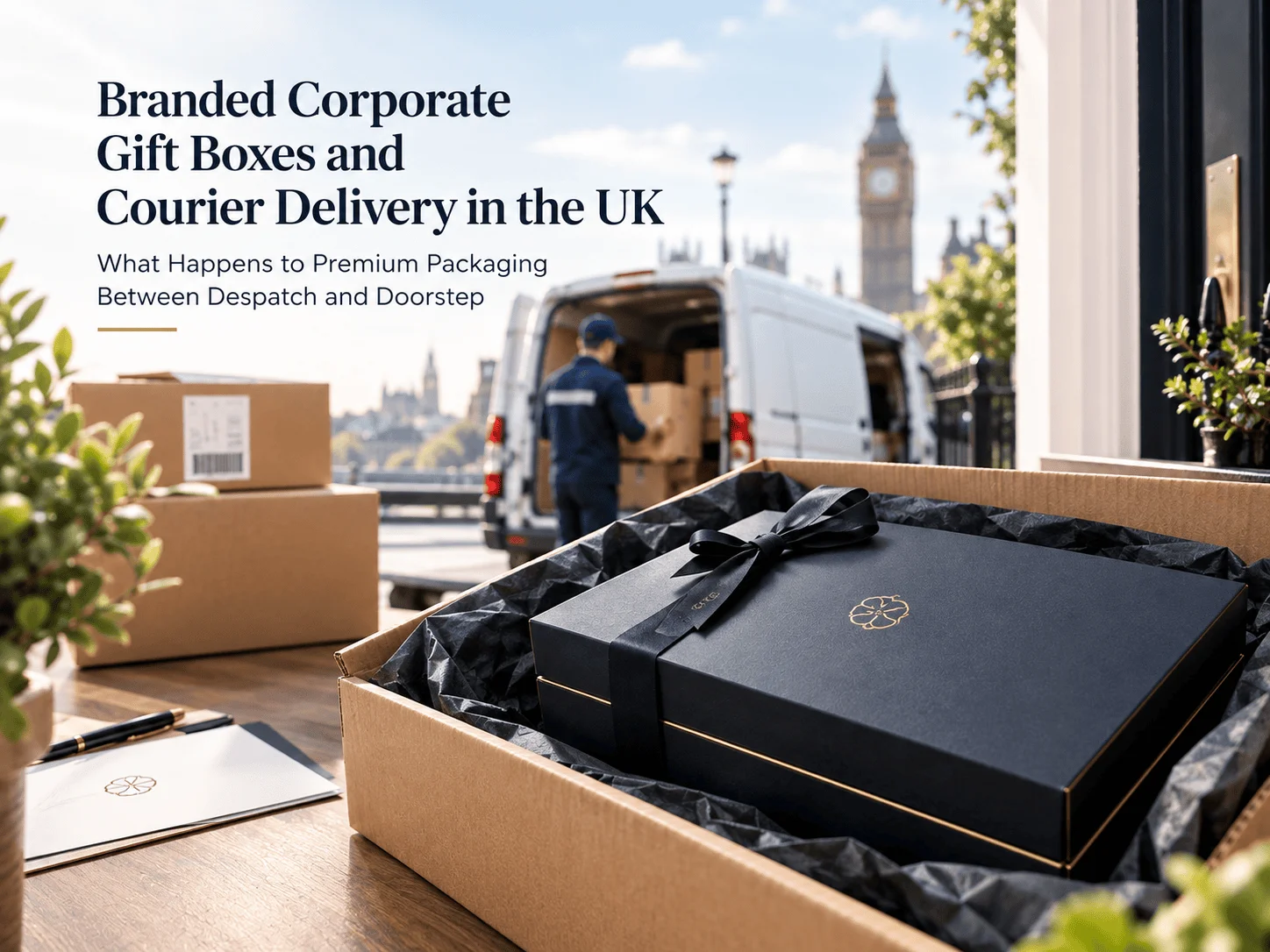
A branded corporate gift box leaves a UK fulfilment centre looking exactly as it should. The magnetic closure sits flush. The soft-touch lamination is unmarked. The foil-stamped logo catches the light precisely as the designer intended. The tissue inside is folded correctly and the contents are positioned at the presentation height that the interior insert was engineered to achieve. Somewhere between that moment and the moment a client opens the delivery at their desk in a Manchester law firm or a Bristol consultancy, something happens that the brand never accounted for when it approved the packaging specification.
The parcel travels through a UK courier network whose handling conditions were not designed with premium branded packaging in mind. Sortation facilities move parcels at speeds and across conveyor transitions that apply impact forces no quality inspection process replicates. Vans carry mixed loads whose shifting and compression during transit create pressure conditions that the packaging specification was never tested against. Last-mile delivery involves handling by individuals whose time pressure doesn’t accommodate the care that a premium branded corporate gift box communicates as its own expectation. The client who opens the delivery to find a dented corner, a foil surface scuffed by courier label adhesive, or a lid that no longer closes with the precision it had when it left the fulfilment centre is receiving a message about the sending organisation that is precisely the opposite of the message the gift was designed to deliver.
This guide addresses what UK courier networks actually do to branded corporate gift boxes between despatch and delivery, which specification decisions prevent the most common damage patterns, and what outer packaging and fulfilment practices protect the premium presentation investment from the courier handling realities it will encounter regardless of which carrier is used.
What UK Courier Networks Actually Do to Parcels
Understanding the physical journey a branded corporate gift box takes through a UK courier network requires moving beyond the tracking page narrative of collected, in transit, out for delivery and examining what each stage of that journey physically involves.
Collection from a fulfilment centre involves loading into a van whose cargo area will be filled with parcels of varying sizes, weights, and structural strengths over the course of a collection round. The branded corporate gift box whose outer packaging isn’t rigid enough to resist compression from adjacent parcels is being compressed from the moment it enters the collection vehicle, and this compression may have already affected the magnetic closure alignment and corner geometry of the premium box inside before the parcel reaches the first sortation facility.
Primary sortation at a regional hub involves conveyor systems running at speeds that move parcels from receiving to primary sorting in minutes. Parcels placed on high-speed conveyors accelerate and decelerate through curves and drop points that apply impact forces to whatever faces of the parcel contact the conveyor surface. Parcels whose outer packaging doesn’t distribute these impact forces across their structure concentrate them at the weakest points, which for branded corporate gift boxes are typically the corners and the closure mechanism whose precision is most sensitive to deformation.
Secondary sortation for delivery route organisation applies a second round of mechanical handling that includes the belt junction transitions where parcels move between conveyor systems at angles that create drop impacts. The height of these transitions varies between facilities and between different vintage conveyor systems within facilities, but drops of 10 to 30 centimetres are common at belt junctions whose design prioritises throughput volume over parcel condition.
The delivery van loading process organises parcels by delivery sequence rather than by fragility or stacking suitability. A branded corporate gift box in a correctly specified outer carton may be loaded beneath heavier parcels whose combined weight over a transit period of two to four hours creates sustained compression loading that rigid box constructions resist effectively and non-rigid outer packaging doesn’t. The ambient temperature inside delivery vans during summer months adds a material performance dimension that adhesive specifications and board constructions calibrated for standard temperature conditions don’t automatically accommodate.
Last-mile delivery by drivers operating under timed delivery pressures involves parcel handling whose care level reflects the operational reality of completing a delivery round within a time window rather than the presentation quality expectations of the premium branded packaging being delivered. Parcels placed rather than positioned, letterbox attempts on parcels that don’t fit, and safe place deliveries that leave premium branded parcels exposed to weather conditions all represent last-mile handling realities that specification decisions need to account for.
Which Damage Patterns Appear Most Consistently on Premium Gift Packaging
The damage patterns that branded corporate gift boxes experience through UK courier delivery are consistent enough across carriers and routes that they reveal specific structural vulnerabilities rather than random handling failures, and each pattern points toward a corresponding specification decision that prevents or reduces it.
Corner and edge damage is the most common damage pattern because corners concentrate impact stress in ways that flat panel areas distribute. A branded corporate gift box whose outer packaging presents corners as the most exposed structural elements to impact will show corner crushing, corner delamination, or corner crease damage that affects both the outer packaging and the premium box inside. This damage pattern is directly preventable through outer packaging that protects corners specifically rather than relying on general structural rigidity to distribute corner impacts.
Surface scuffing and abrasion damage affects the premium finishes that branded corporate gift boxes invest most heavily in, including soft-touch lamination, foil stamping, and spot UV surfaces, whose surface quality is precisely what the packaging investment was designed to protect and present. These surfaces scuff against adjacent parcels during sortation conveyor travel and against van cargo surfaces during transit in ways that standard lamination and coating surfaces resist adequately but that premium finishes require additional protection against. Soft-touch lamination in particular is more susceptible to surface marking than standard gloss or matte lamination because its open surface structure, whose tactile quality is its primary commercial attribute, also creates more surface area for friction-induced marking than the sealed surface of conventional lamination.
Closure damage affects magnetic closures whose precise alignment depends on dimensional consistency that compression and impact loading compromises. A magnetic closure that closes with satisfying precision when the box is dimensionally correct develops a loose or misaligned closure when the box has been compressed by 2 to 3 millimetres in any dimension during transit. The client’s first physical interaction with the gift box is the closure, and a closure that doesn’t perform with the precision it communicates as its own expectation undermines the quality signal that the entire packaging investment was designed to create at this specific moment.
Courier label adhesive damage occurs when labels are applied directly to premium packaging surfaces or when labels applied to outer packaging bleed adhesive through tears or alongside label edges that contact the premium surface beneath. This damage pattern is entirely preventable through outer packaging design that positions courier label application away from premium surface contact, but it requires deliberate design rather than default assumption that the courier label will be placed away from sensitive surfaces.
What Outer Packaging Specification Prevents Courier Damage
The outer packaging that protects branded corporate gift boxes through UK courier delivery needs to be specified as a functional product protection system rather than selected as a default from whatever options the fulfilment partner uses as standard, because default options are calibrated for average parcel protection rather than for premium branded packaging whose surface quality and dimensional precision require above-average protection to survive courier handling intact.
Corrugated outer cartons whose internal dimensions create a snug fit around the branded corporate gift box without compression gaps that allow movement during transit provide the foundation of effective courier protection. A correctly sized outer carton prevents the interior movement during sortation impacts that creates the corner-to-wall contact forces responsible for corner damage on the premium box inside. This dimensional precision requirement means that a single outer carton size serving multiple gift box dimensions is almost always providing inadequate fit for at least some of the boxes it’s used for, and branded corporate gifting programmes that use a single outer carton across varied gift box dimensions should assess whether the protection provided is adequate for each specific combination.
Corner protection inserts, either custom-formed corrugated corner pieces or moulded pulp corner guards, address the corner concentration vulnerability that causes the most consistent courier damage pattern. These inserts sit between the branded corporate gift box and the outer carton at each corner, absorbing impact energy through their own deformation rather than transmitting it to the premium box they’re protecting. Corner protection adds modest cost per unit and adds slightly to the parcel’s outer dimensions but prevents the corner damage that creates the most visible quality failures at the moment of recipient opening.
Tissue or foam interleaving between the branded corporate gift box surfaces and the outer carton walls prevents the surface-to-surface contact that creates abrasion damage on premium finishes during transit. This interleaving doesn’t need to be structurally significant to be effective. A single layer of tissue against each major panel face of the premium box, held in place by the snug fit of the outer carton, prevents the contact that sortation conveyor travel creates between the premium surface and the corrugated interior wall of the outer carton.
Outer carton labelling zones specified during fulfilment partner briefing, communicating to the fulfilment team where courier labels should be applied to prevent adhesive damage to premium surfaces, require explicit instruction rather than assumption. A briefing document that includes a diagram showing the approved label placement zone and the surfaces that should not contact label adhesive or label edges, issued to every fulfilment partner handling branded corporate gift box despatch, prevents the adhesive damage that default label placement creates without this guidance.
What Carrier Selection Means for Premium Branded Gift Packaging
UK carrier selection for branded corporate gift box delivery involves a trade-off between delivery speed, tracking quality, and handling reliability whose practical implications for premium packaging differ from the implications for standard commercial parcel delivery.
Royal Mail Tracked 24 and Tracked 48 services deliver through a network whose final delivery model uses postmen and postwomen whose handling culture includes more care for individual parcels than the high-speed sortation environments of express courier networks. The trade-off is network speed and tracking granularity, where Royal Mail’s tracking is less detailed than DHL, DPD, or UPS equivalents, and delivery speed is less consistent than express courier guarantees. For branded corporate gift boxes where delivery timing flexibility exists and where last-mile handling quality is the primary concern, Royal Mail tracked services provide a handling environment that is gentler for premium packaging than express courier alternatives.
DPD’s Predict service, whose one-hour delivery window notification system reduces the proportion of failed delivery attempts whose consequence is safe place delivery or redelivery holding conditions, provides delivery experience management that other carriers don’t replicate. For branded corporate gift boxes where failed delivery leading to depot holding conditions creates ambient storage risk and redelivery handling risk, DPD’s Predict notification system reduces these risks by improving the probability that the recipient is present at delivery rather than away from their desk or office when the parcel arrives.
Specialist B2B delivery services, including those operated by logistics providers specifically for business address delivery rather than residential, provide handling environments calibrated for professional recipient contexts in ways that general consumer parcel networks aren’t. These services cost more per delivery than standard consumer courier networks but deliver branded corporate gift boxes to business addresses with handling reliability that standard consumer networks don’t consistently provide when delivering to office building reception environments whose acceptance procedures and internal parcel handling practices vary.
What UK Fulfilment Partners Need to Know Before Handling Premium Gift Packaging
The briefing conversation between a brand commissioning branded corporate gift boxes and the fulfilment partner handling their despatch is the most operationally consequential conversation in the premium packaging delivery chain, and it needs to cover specific handling requirements rather than assuming that premium packaging labels or general care instructions will translate into the specific handling practices that protect premium finishes and structural precision through the courier journey.
Pack station setup requirements for branded corporate gift box programmes include outer carton selection guidance, interior padding specification, and tissue or foam interleaving placement instructions that fulfilment partners whose standard operations handle a range of packaging types need to receive as specific written guidance rather than inferring from the packaging’s appearance. A pack station briefing document that includes photographs of correctly packed examples alongside the written specification provides the visual reference that prevents interpretation variability between different pack station operators.
Quality control checks before despatch, including visual inspection of the branded corporate gift box for surface damage, closure alignment, and interior presentation accuracy, and inspection of the packed outer carton for correct padding placement and secure closure, create the quality gate between production and despatch that prevents damaged or incorrectly packed units from entering the courier network. These checks add time per unit at the pack station but prevent the customer experience failures that courier damage creates at the recipient end, where the brand’s only available remedy is replacement rather than correction.
Courier handover conditions, including whether parcels are handed to courier drivers or loaded directly onto collection vehicles without driver inspection, affect whether the handled-with-care briefing provided to the fulfilment partner influences the first handling event in the courier journey or only the pack station step before it. Programmes where courier collection involves direct driver contact benefit from outer packaging that communicates premium contents through its presentation, because driver awareness of premium contents affects first-stage handling care in ways that generic brown carton outer packaging doesn’t activate.
Aly Packaging UK produces branded corporate gift boxes with structural specifications calibrated for UK courier delivery conditions, including board grades and closure mechanisms that maintain dimensional integrity through the handling journey from despatch to doorstep. Contact our UK team at sales@alypackaging.com or call 1-844-259-7225 to discuss your corporate gift box specification and what outer packaging approach protects your premium presentation investment through delivery.


