
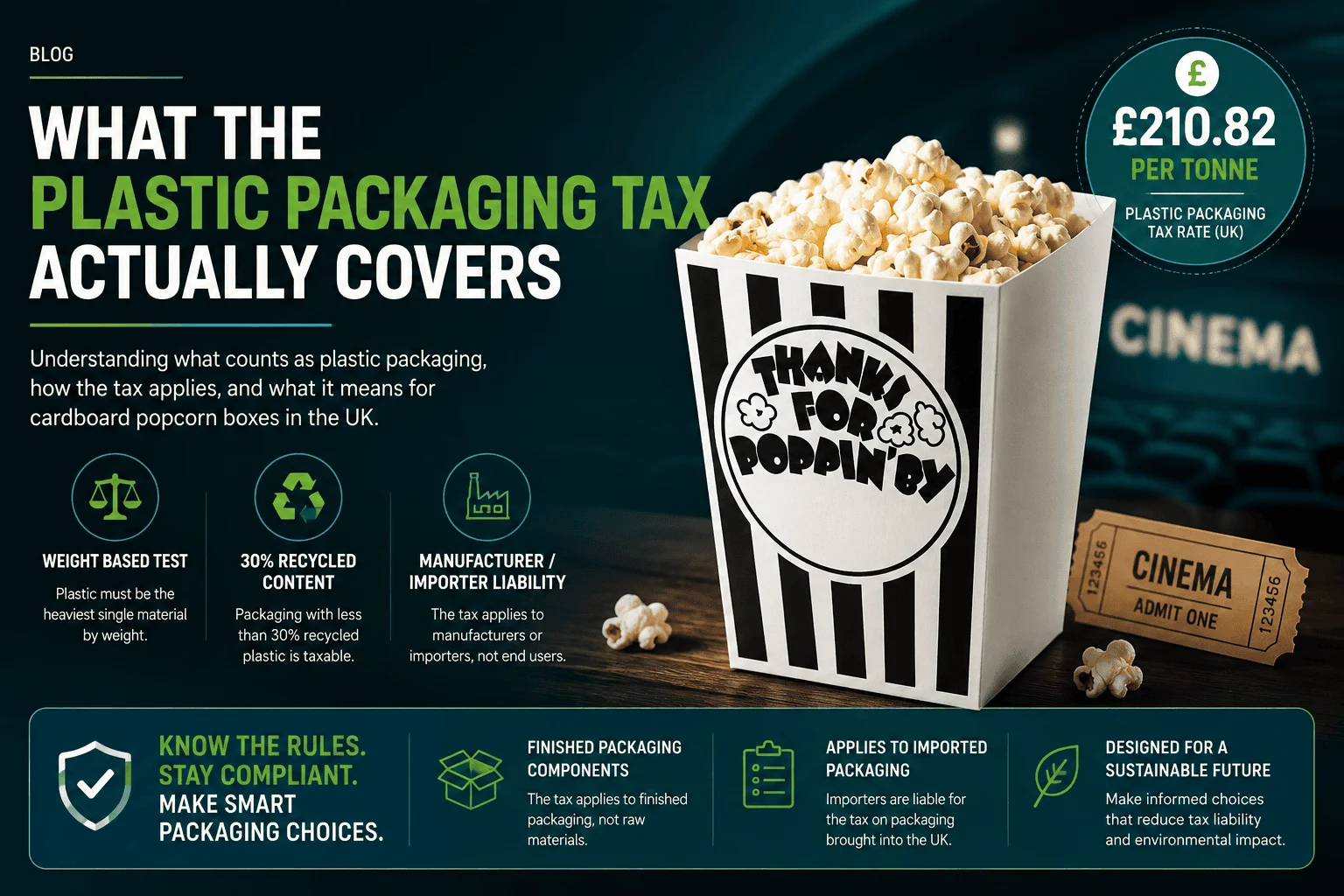
UK cinema operators and event vendors ordering cardboard popcorn boxes have been navigating the Plastic Packaging Tax since its introduction in April 2022 with varying degrees of awareness about whether their packaging orders are caught by the tax, whether they carry the tax liability themselves or their supplier does, and what the recycled content requirements mean for the specification decisions they make when placing orders. The confusion is understandable. The tax applies to plastic packaging, and cardboard popcorn boxes don’t look like plastic packaging to anyone who hasn’t read the legislation carefully. The problem is that the legislation’s definition of plastic packaging is broader than the everyday meaning of the word plastic, and cardboard popcorn boxes with certain constructions fall within it in ways that vendors ordering on visual assessment rather than material analysis don’t anticipate.
This isn’t a marginal compliance edge case affecting a small number of unusual packaging formats. It’s a structural feature of how the UK Plastic Packaging Tax defines its scope that affects a meaningful proportion of the cardboard popcorn boxes sold to UK cinema operators and event vendors, and the cost implications flow through the supply chain in ways that show up on invoices without always being explained clearly. Understanding which cardboard popcorn box constructions are caught by the tax, who bears the cost, and what specification decisions reduce or eliminate tax liability changes how UK cinema and event vendors approach their next packaging order.
What the Plastic Packaging Tax Actually Covers
The UK Plastic Packaging Tax is levied at £210.82 per tonne on plastic packaging manufactured in or imported into the UK that contains less than 30 percent recycled plastic content by weight. The tax applies to finished packaging components rather than to raw materials, and it applies to the manufacturer or importer of the packaging rather than to the business that ultimately uses it, which is why the tax cost appears on supplier invoices rather than as a separately reported liability for most cinema and event vendors.
The definition of plastic packaging under the legislation is where cardboard popcorn boxes enter the conversation. The legislation defines plastic packaging as packaging where plastic is the heaviest single material by weight. This definition creates a threshold test rather than a categorical test, meaning the question isn’t whether a package contains plastic but whether plastic is the single heaviest material in the package. A cardboard popcorn box that is entirely paperboard with no plastic component fails this test and falls outside the tax’s scope entirely. A cardboard popcorn box whose grease-resistant coating consists of a polyethylene layer applied to the interior surface needs to be assessed against the weight of the paperboard and the weight of the polyethylene to determine whether the PE layer is heavy enough to make plastic the single heaviest material in the finished box.
For most standard cardboard popcorn boxes with light PE interior coatings applied at standard coating weights, the paperboard component substantially outweighs the PE coating layer, meaning the paperboard remains the heaviest single material and the packaging falls outside the Plastic Packaging Tax’s scope. The packaging becomes potentially liable when non-standard constructions use heavier plastic components, including thicker PE liners, multi-layer plastic coatings combining PE with other plastic layers, or additional plastic elements such as window films applied to display boxes. Cinema and event vendors who order cardboard popcorn boxes with window cutouts covered by plastic film, or with multi-layer interior barrier coatings including significant plastic content, should ask their supplier to confirm whether the construction crosses the threshold at which plastic becomes the heaviest material.
Who Pays the Tax and How It Reaches Vendor Invoices
The Plastic Packaging Tax liability sits with the manufacturer or importer of the packaging rather than with the business using the packaging in their operations. A UK cardboard popcorn box manufacturer whose box constructions include enough plastic content to fall within the tax’s scope pays the tax on the tonnage of liable packaging they produce and recovers this cost through their product pricing. An overseas manufacturer shipping cardboard popcorn boxes directly to a UK business creates an import liability that the UK business importing the packaging bears, because the importer is the relevant person for the purposes of the tax on imported packaging.
The practical consequence for UK cinema and event vendors is that Plastic Packaging Tax costs appear in their packaging pricing through two separate mechanisms. Suppliers whose popcorn box constructions are caught by the tax incorporate the tax cost into their standard product pricing, and the per-unit cost increase from the tax reflects the tax rate applied to the plastic content of each box at the relevant production weight. This cost pass-through is standard practice and is commercially legitimate, but vendors who don’t understand that the tax is contributing to their per-unit cost can’t assess whether alternative constructions with lower plastic content would reduce their packaging cost by moving out of the tax’s scope.
The second mechanism affects vendors who import cardboard popcorn boxes directly from overseas manufacturers outside the UK. Businesses that are registered for UK Plastic Packaging Tax purposes and import packaging with less than 30 percent recycled plastic content by weight are liable to declare and pay the tax on those imports. Cinema and event vendors who source directly from Chinese or European manufacturers without going through a UK-based packaging supplier may not be aware that they bear this import liability, particularly if they haven’t assessed whether their imported box construction crosses the threshold at which plastic becomes the heaviest material. HMRC has been progressively extending its awareness and enforcement activity around PPT import obligations as the tax matures, and vendors who import directly should seek confirmation of their liability position rather than assuming that cardboard packaging is categorically exempt.
What Recycled Content Requirements Mean for Cardboard Popcorn Box Orders
The 30 percent recycled plastic content threshold that determines tax liability creates a specification decision for cardboard popcorn box constructions that include enough plastic to potentially fall within the tax’s scope. A box construction whose plastic content is the heaviest single material, or approaches this threshold, can potentially move outside the tax’s scope through incorporating 30 percent or more recycled plastic content by weight in the plastic components of the construction.
For cardboard popcorn boxes with PE interior coatings, the recycled content requirement applies to the PE coating material rather than to the entire box. Post-consumer recycled PE is commercially available and is used by responsible packaging manufacturers in food-contact coating applications where the recycled content meets food safety requirements for indirect food contact applications. Boxes with PE coatings using 30 percent or more post-consumer recycled PE content by weight of the PE layer would, if the PE layer is the heaviest single material in the construction, be exempt from the tax through the recycled content exemption rather than through falling outside the material threshold test.
Cinema and event vendors who order cardboard popcorn boxes and want to understand their tax position or reduce the tax cost in their supply chain should ask their supplier two specific questions. First, whether the box construction crosses the threshold at which plastic is the heaviest single material by weight. Second, if the construction is within scope, whether the plastic components use 30 percent or more recycled plastic content by weight that would qualify the packaging for the recycled content exemption. Suppliers who have assessed their constructions against the Plastic Packaging Tax framework will have this information available. Suppliers who haven’t will need time to assess it, which is itself informative about whether the supplier has a systematic approach to PPT compliance or is managing it reactively.
What Documentation the Tax Creates for Vendor Relationships
UK businesses that are caught by the Plastic Packaging Tax as manufacturers or importers must maintain records demonstrating their liability position, including records of packaging weights, material compositions, recycled content percentages, and any exemptions claimed. This documentation obligation creates a secondary benefit for cinema and event vendors whose suppliers are PPT-compliant, because the records that suppliers maintain for their own compliance purposes contain material composition information that vendors can use for their own packaging assessments.
Vendors who ask their UK-based cardboard popcorn box supplier for confirmation of the tax position on their specific box constructions, and whether the supplier’s pricing includes PPT cost recovery for any liable constructions, create a documented record of their supply chain’s tax position that is useful both for their own financial planning and for managing the pricing transparency of their supplier relationships. A supplier who can confirm specifically that a standard-construction cardboard popcorn box falls outside the tax’s scope because paperboard is the heaviest single material demonstrates both PPT awareness and the material composition knowledge that responsible packaging procurement requires.
Vendors who import directly and who have assessed that their imported constructions are within scope need to register for UK Plastic Packaging Tax with HMRC and submit quarterly returns declaring their liable import tonnage and the tax due. The registration threshold is ten tonnes of liable packaging per year, below which businesses are exempt from registration and payment obligations though not from the obligation to assess their position and maintain records. Cinema and event vendors who import modest quantities of cardboard popcorn boxes directly may fall below this threshold, but the assessment obligation exists regardless of whether the tonnage threshold is met.
What Specification Decisions Reduce PPT Exposure for Cardboard Popcorn Boxes
The specification decisions that most reliably reduce or eliminate Plastic Packaging Tax exposure for cardboard popcorn boxes are those that reduce plastic content below the threshold at which plastic becomes the heaviest single material, or that incorporate sufficient recycled plastic content to qualify for the recycled content exemption.
Specifying water-based barrier coatings rather than PE coatings for grease resistance creates a material composition where the coating content is water-based acrylic or similar polymer rather than polyethylene, which may not be classified as plastic under the legislation depending on the specific chemical classification of the coating material. The classification of specific coating chemistries under PPT legislation is a technical question that requires assessment against the legislation’s definition of plastic rather than a general assumption that water-based coatings fall outside the tax’s scope. Vendors whose suppliers use water-based barrier coatings should ask for confirmation of the classification position rather than assuming exemption.
Specifying uncoated board for cardboard popcorn box applications where the product allows it eliminates any plastic content question entirely. Standard dry popcorn without butter or oil topping may tolerate uncoated board for short service periods, and vendors who can operationally manage the grease resistance limitation through service protocols rather than through coating specifications eliminate the plastic content question at its source.
Choosing constructions without plastic window films eliminates the most straightforward route through which additional plastic content enters cardboard popcorn box constructions above the standard board and coating combination. Display formats for premium or gourmet popcorn products that incorporate plastic window cutouts should be assessed for whether the window film weight is sufficient to move the construction closer to or across the plastic-as-heaviest-material threshold.
What UK Cinema and Event Vendors Should Do Before Their Next Order
The practical actions that reduce uncertainty around Plastic Packaging Tax for UK cinema and event vendors ordering cardboard popcorn boxes are straightforward and don’t require specialist tax expertise to initiate.
Asking the supplier specifically whether the box construction is within scope of the Plastic Packaging Tax, meaning whether plastic is the heaviest single material by weight, provides the fundamental information needed to assess the vendor’s position. A supplier who can answer this question with material composition data is managing their PPT compliance systematically. A supplier who cannot answer it is either not within scope because their constructions clearly fall outside the tax’s material threshold, or is managing compliance less systematically than UK legislation requires.
Asking whether the supplier’s pricing includes PPT cost recovery for any construction within scope provides clarity about whether the tax cost is already embedded in the quoted per-unit price or whether it would be added separately. Understanding this allows vendors to make accurate cost comparisons between suppliers using different constructions and different PPT positions.
Confirming recycled content percentages for any plastic components in the construction provides the information needed to assess whether the recycled content exemption applies and whether specification changes incorporating higher recycled plastic content would qualify the packaging for exemption in a way that reduces the supplier’s PPT liability and potentially their pricing.
Aly Packaging UK works with cinema operators and event vendors across the UK developing cardboard popcorn box specifications that address Plastic Packaging Tax implications alongside structural, print, and presentation requirements. Contact our UK team at sales@alypackaging.com or call 1-844-259-7225 to discuss your popcorn box specification and tax position before your next order.


