
There is a consistent gap in UK sustainable ecommerce packaging that brands discover only after investing in it. The gap is between what British online shoppers say they want from sustainable packaging when asked in surveys, and what they actually notice, respond to, and change their purchasing behaviour based on when they receive a parcel at their door. These are measurably different things, and the brand that conflates them spends money on sustainability signals that don’t register commercially while missing the signals that do.
UK sustainable packaging research is unusually active relative to other markets because the convergence of regulatory pressure from the Plastic Packaging Tax, retailer sustainability commitments, and a consumer base that has developed genuine environmental awareness has made the UK one of the most researched markets for consumer response to packaging sustainability. The research is worth understanding directly rather than through the filtered version that appears in marketing materials, because the filtered version consistently overclaims consumer attention to sustainability signals that real purchasing behaviour data doesn’t support, while underclaiming the signals whose commercial impact is demonstrably real.
What UK Consumers Say They Want Versus What Changes Their Behaviour
The stated preference data on UK consumer attitudes to sustainable ecommerce packaging is robust and consistently directional. Around 77 percent of UK consumers say they are concerned about the environmental impact of packaging, and a significant majority say they would prefer to buy from brands using sustainable packaging over those that don’t when price and quality are equal.
The behavioural data tells a more complicated story. The attitude-behaviour gap in sustainable purchasing is well documented in UK consumer research, and it operates specifically in ecommerce packaging contexts where the packaging is received after the purchase decision has already been made rather than influencing it at point of sale. A UK consumer who would theoretically prefer sustainable packaging has already completed their purchase before they encounter the ecommerce packaging, which means sustainability signals in delivery packaging influence repeat purchase decisions rather than initial purchase decisions. The timing of the signal matters commercially because it changes what the brand needs the sustainability communication to achieve.
Research from the UK’s Packaging Digest and consumer behavioural studies consistently shows that the sustainable packaging attributes UK consumers notice most reliably are those they interact with physically rather than those communicated through labelling. A consumer who receives a parcel whose packaging feels thin and inadequate forms a quality impression regardless of what the sustainability label on it claims. A consumer who receives a parcel whose packaging feels considered and well-constructed forms a quality impression that the sustainability credentials then enhance rather than establish. The physical experience precedes the label reading, which means the sustainability signal only operates commercially after the quality signal has been established rather than independently of it.
Which Sustainable Packaging Materials UK Consumers Actually Recognise
The material recognition gap in UK sustainable ecommerce packaging creates a specific marketing efficiency problem: brands investing in materials whose sustainability credentials are genuine but whose visual and tactile difference from conventional materials is imperceptible to consumers are making an environmental investment that generates no commercial return from the consumer perception pathway.
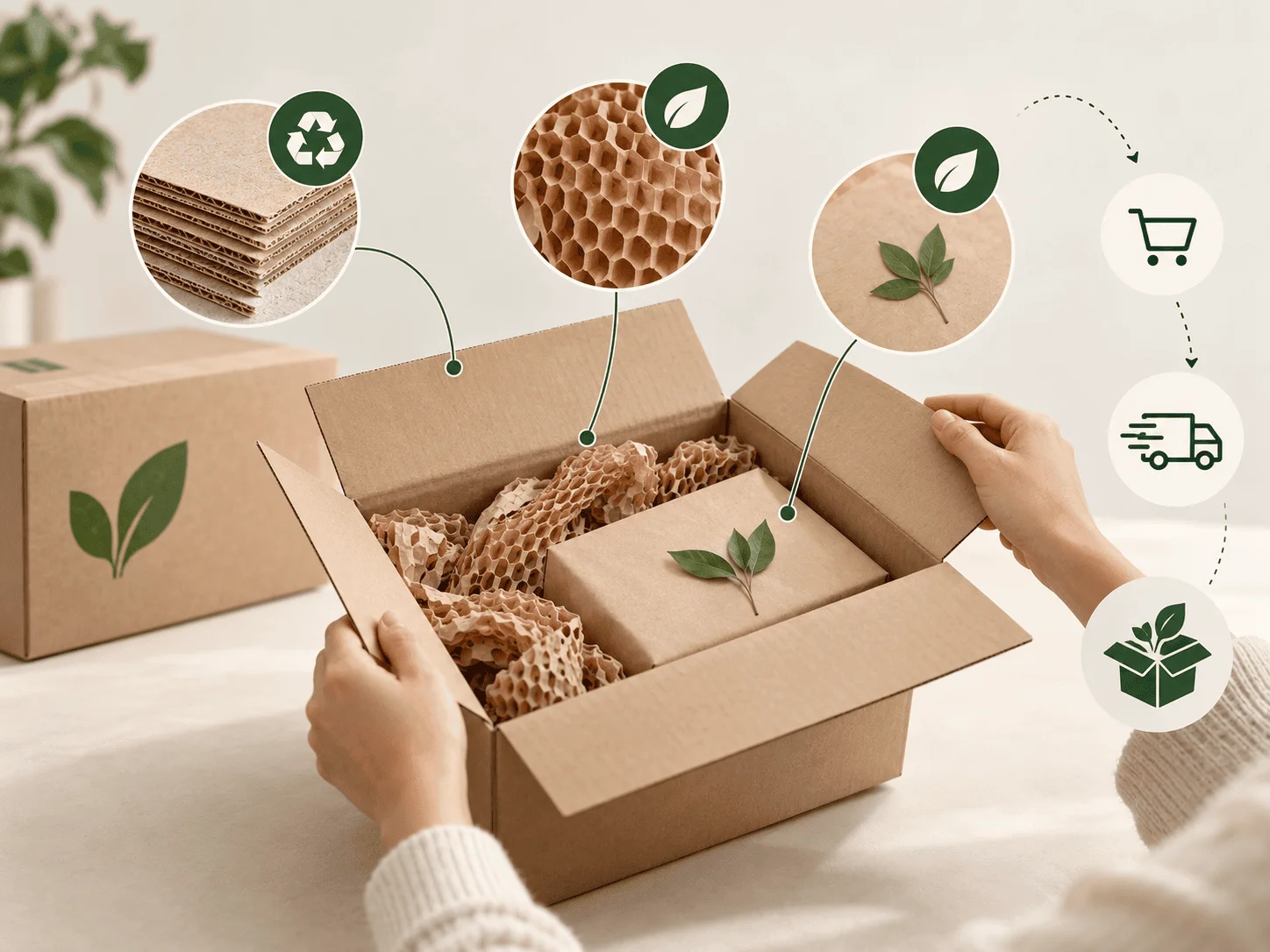
Recycled content paperboard is the clearest example of this recognition gap. A mailer box produced from 80 percent post-consumer recycled content is genuinely more sustainable than an equivalent box produced from virgin board, and the recycled content claim on the box is accurate. British consumers who read this claim and understand it will respond positively. British consumers who don’t examine the label closely, which represents the majority of recipients whose interaction with ecommerce packaging is functional rather than analytical, will not notice the material difference because recycled content paperboard of adequate quality looks and feels identical to virgin board. The sustainability investment produces an environmental benefit but the consumer perception commercial benefit requires the consumer to actively seek and process the recycled content claim.
Paper-based void fill, replacing plastic bubble wrap and air cushions, is a material change whose consumer recognition rate is substantially higher than recycled content board precisely because it produces a visible and tactile difference that consumers encounter directly when opening the parcel. UK consumers who have received ecommerce parcels with plastic void fill and subsequently receive the same brand’s parcels with paper void fill notice the change without being prompted to look for it, because the physical interaction of removing paper void fill differs from removing plastic void fill in ways that are immediately apparent. This unprompted recognition makes paper void fill one of the highest commercially-effective sustainability switches available to UK ecommerce brands because it creates the consumer awareness that drives the repeat purchase sustainability credit without requiring active consumer engagement with sustainability labelling.
Compostable mailers occupy an interesting position in UK consumer recognition because their visual resemblance to conventional plastic mailers means they’re often not recognised as different without reading the label, yet when consumers do read the label and understand what compostable means, their response is strongly positive. The compostable mailer’s commercial effectiveness in the UK market therefore depends on label design that draws attention to the material claim rather than on the material’s inherent visual difference, which is the opposite of the paper void fill dynamic where the material itself creates unprompted consumer awareness.
What UK Consumers Actually Read on Sustainable Ecommerce Packaging
The label reading behaviour of UK ecommerce consumers at the point of parcel receipt differs from the label reading behaviour of supermarket shoppers because the context is different. A supermarket shopper examining packaging before purchase has a decision-relevant reason to read labels carefully. An ecommerce recipient opening a delivery has already made the purchase decision and is engaged in unpacking a product they’ve been anticipating, whose packaging is a pathway to the product rather than a decision input.
In this post-purchase unpacking context, UK consumer research consistently shows that label reading is selective rather than comprehensive. Labels that are positioned directly in the interaction path, meaning on surfaces the consumer handles while opening the packaging, receive substantially higher reading rates than labels positioned on surfaces the consumer doesn’t need to handle during unpacking. A sustainability label on the inside of a mailer box flap that the consumer grips when opening is in the interaction path. The same label on the exterior base of the box receives lower attention because most consumers don’t rotate the box to examine its base surface.
The Australasian Recycling Label system’s UK equivalent, the How2Recycle label from OPRL, has developed consumer recognition in the UK market through sustained retailer adoption that has created familiarity with the iconography across a broad UK consumer base. British consumers who encounter the OPRL label on ecommerce packaging have a higher probability of correctly interpreting its recyclability guidance than consumers encountering text-based recyclability claims without the recognised iconography. This recognition differential means that packaging using OPRL certification and labelling generates more accurate consumer understanding of its recyclability than equivalent packaging with self-declared recyclability text.
What Makes British Consumers Trust Sustainable Ecommerce Packaging Claims
The trust dimension of UK sustainable ecommerce packaging operates through a scepticism filter that has developed in response to the proliferation of unsubstantiated sustainability claims that British consumers have encountered across consumer goods categories over the past several years.
UK consumer research from 2025 and 2026 consistently shows that British shoppers apply greater scepticism to broad environmental packaging claims than to specific, verifiable ones. The phrase sustainable packaging generates lower trust scores than the phrase this box is made from 80 percent post-consumer recycled content, FSC certified across the same UK consumer sample, because the latter provides specific information that can be verified against external standards while the former provides no information beyond a brand’s self-assessment of its own environmental standing.
This specificity-trust relationship has direct implications for how UK ecommerce brands should structure their sustainable packaging communication. Specific claims with third-party certification generate trust. General claims without certification generate scepticism that may actively reduce brand credibility with the consumer segment whose environmental engagement is highest and whose purchasing behaviour is most influenced by genuine sustainability credentials. A UK ecommerce brand that prints eco-friendly packaging across its mailer boxes without supporting specifics may be communicating less credibly to its most environmentally engaged customers than a brand that makes no sustainability claim at all.
The third-party certification signal is particularly powerful in the UK market because British consumer culture’s trust in independent verification over brand self-declaration extends specifically to environmental claims. FSC chain-of-custody certification, OPRL recyclability labelling, and the Carbon Trust’s packaging footprint certification all carry recognition and credibility in the UK market that self-declared equivalent claims don’t replicate. Investment in certification creates the trust infrastructure that sustainability labelling requires to work commercially, and without this infrastructure the labelling investment produces returns only from the minority of consumers whose independent research validates the brand’s unverified claims.
What UK Consumers Penalise in Sustainable Ecommerce Packaging
The penalty side of UK consumer response to sustainable ecommerce packaging, the packaging decisions that actively reduce brand perception rather than simply failing to enhance it, is less discussed than the positive signal side but commercially more significant because the negative impact on repeat purchase probability exceeds the positive impact of equivalent sustainability investment in most documented cases.
Over-packaging is the most consistently penalised sustainable packaging failure in the UK ecommerce context. British consumers who receive a small product in a large box, regardless of the box’s recycled content or recyclability credentials, respond negatively to the visible excess material in ways that override whatever positive sustainability signal the certification labels communicate. The cultural dimension of this response in the UK market is specific: British consumer culture’s association between restraint and quality means that obvious over-packaging communicates both environmental carelessness and poor judgement simultaneously, a combination whose brand impression damage exceeds what either signal would produce independently.
Difficult recyclability despite recyclable claims creates a consumer trust penalty that research documents specifically in the UK market. British consumers who encounter ecommerce packaging labelled as recyclable and then discover through their own recycling experience that their local collection infrastructure doesn’t accept the material record the experience as a specific trust violation rather than a general sustainability disappointment. The UK’s varied local authority recycling infrastructure, whose inconsistency means that packaging recyclable in one area may be non-recyclable in another, creates specific liability for ecommerce brands whose recyclability claims aren’t qualified against infrastructure availability.
Visible quality compromise in the name of sustainability, specifically packaging whose structural integrity has been reduced through material lightweighting or material substitution to the point where it fails to protect products adequately, generates the most commercially damaging consumer response of any sustainable packaging failure mode. A product that arrives damaged in sustainable packaging creates a brand experience whose negativity exceeds what the same product arriving damaged in conventional packaging would create, because the sustainable packaging has created an expectation of considered quality that the damage failure then violates specifically. British consumers who receive a damaged delivery in packaging that has been obviously lightweighted in the name of sustainability are more likely to attribute the damage to the packaging decision than equivalent consumers receiving damage in conventional packaging, creating a specific brand association between sustainability and inadequate protection whose commercial consequence is measurable in reduced repeat purchase rates.
What UK Ecommerce Brands Should Actually Prioritise
The practical guidance that emerges from UK consumer response research on sustainable ecommerce packaging prioritises actions in a different order from the order that general sustainability frameworks suggest, because the UK consumer recognition, trust, and behaviour change evidence supports some investments more strongly than others.
Reducing packaging size to eliminate obvious over-packaging delivers the clearest commercial return from British consumer sustainability response because it creates unprompted positive perception across the full UK consumer base rather than only the engaged sustainability segment. Every British consumer who opens a parcel that fits the product appropriately forms a positive impression. The sustainability benefit from reduced material use is genuine. The commercial benefit from British consumer response to visible restraint is reliable. These two benefits align, making right-sizing the highest-return sustainable ecommerce packaging investment available to UK online retailers across all consumer segments.
Switching visible materials whose consumer interaction creates unprompted recognition, specifically replacing plastic void fill with paper alternatives, delivers reliable consumer awareness without requiring active label engagement. The commercial return from this switch is higher than the equivalent investment in recycled content board because it operates through physical interaction rather than through label reading, reaching the full consumer base rather than the label-reading subset.
Third-party certification investment creates the trust infrastructure that converts consumer sustainability intent into actual purchasing behaviour change. UK ecommerce brands whose sustainable packaging carries FSC, OPRL, or Carbon Trust certification are providing the independent verification that British consumers’ scepticism of brand self-declaration requires before sustainability claims influence repeat purchase decisions.
Specific, verifiable claims over broad general claims require no additional production investment beyond the messaging decision itself, but they consistently generate higher consumer trust scores and stronger repeat purchase intent across UK consumer research samples. The brand that tells a British consumer exactly what their packaging contains, where it came from, and how to dispose of it correctly is communicating more credibly than the brand communicating sustainable packaging without supporting specifics, regardless of the objective environmental performance differential between the two.
Aly Packaging UK works with online retailers developing sustainable ecommerce packaging whose material choices, construction, and labelling are aligned with what British consumers actually respond to commercially rather than what sustainability frameworks suggest they should respond to in theory. Contact our UK team at sales@alypackaging.co.uk or call +447462212450 to discuss your sustainable ecommerce packaging specification.


