
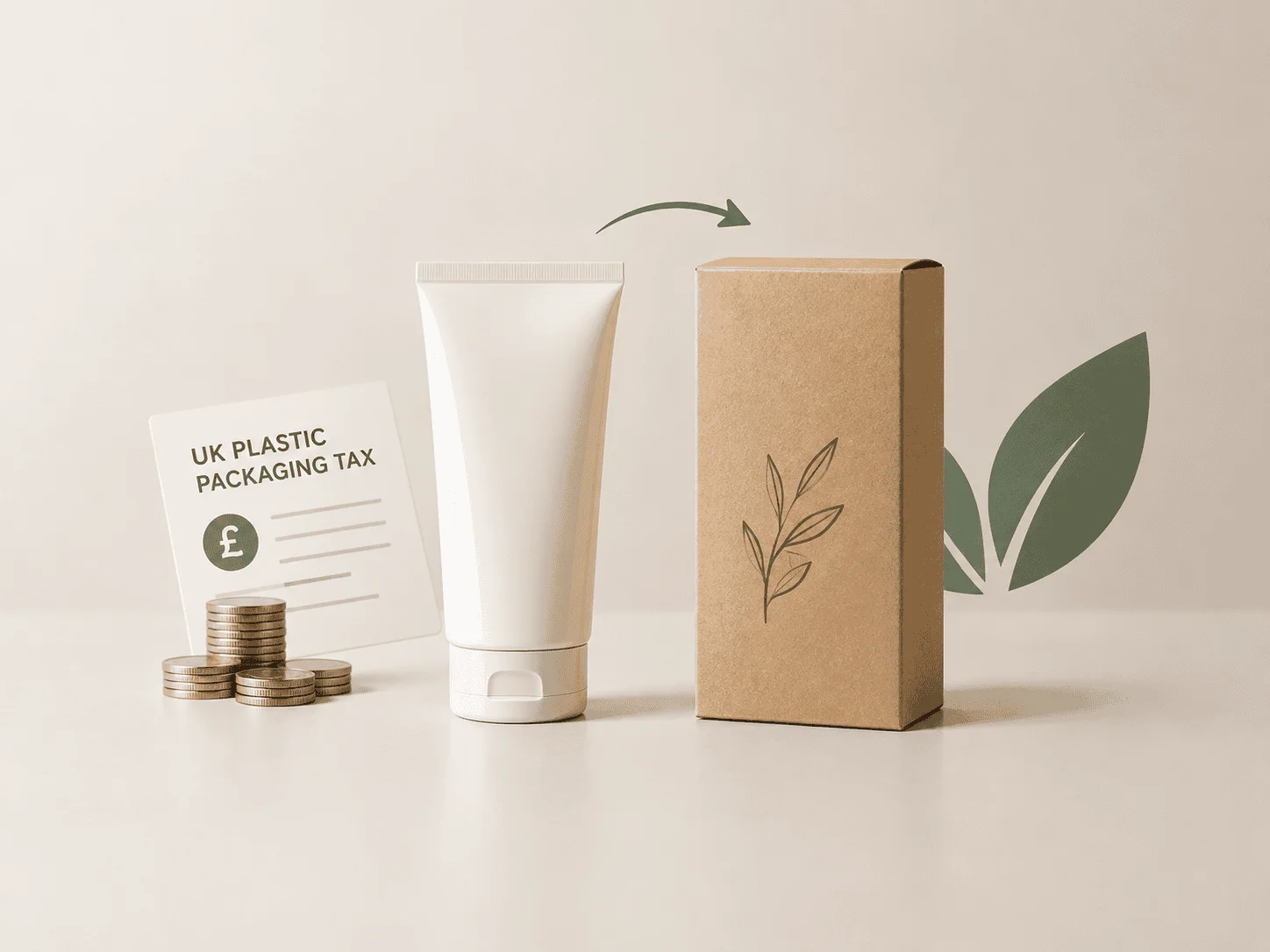
The UK Plastic Packaging Tax has produced a specific category of packaging decision that looks straightforward from the outside and turns out to be considerably more complicated when a beauty brand actually attempts to execute it. The decision is to switch secondary cosmetic packaging from plastic to cardboard, motivated by a combination of genuine sustainability intent and the financial incentive of avoiding the £210.82 per tonne tax on plastic packaging containing less than 30 percent recycled content. The decision looks straightforward because cardboard is obviously not plastic and obviously doesn’t attract a plastic packaging tax. The complications emerge when a beauty brand discovers that the plastic they’re switching away from is performing functions in their secondary cosmetic packaging whose cardboard equivalents either don’t perform the same function equally well, cost more than the tax savings justify, or create new compliance considerations the original plastic packaging didn’t raise.
This isn’t an argument against switching. The environmental case for reducing plastic in cosmetic secondary packaging is genuine, and the PPT financial incentive is real enough to represent meaningful cost pressure for beauty brands producing at commercial volumes. It’s an argument for understanding the switch before committing to it rather than discovering its complications after a packaging specification has been printed in production quantities and a tax calculation has been made against a cost-benefit assumption that didn’t account for the full picture.
What the Plastic Packaging Tax Actually Applies to in Cosmetic Packaging
The first clarification that UK beauty brands often need is which elements of their cosmetic packaging the Plastic Packaging Tax applies to, because the definition of plastic packaging in the legislation is specific enough that the answer isn’t always what visual inspection of the packaging suggests.
The PPT applies to plastic packaging components whose plastic content by weight is the heaviest single material in the component. A secondary cosmetic box made entirely from paperboard with no plastic component falls outside the tax’s scope unambiguously. The complexity arises in the common cosmetic packaging formats that combine paperboard with plastic elements whose weight relative to the board determines whether the PPT applies.
Cosmetic secondary packaging with acetate or PET window panels is one of the most common formats where this material weight question matters commercially. A cardboard cosmetic box with a large PET window panel may or may not have plastic as its heaviest single material depending on the weight of the board used and the size and gauge of the plastic window. A box using standard 350gsm SBS board with a large window panel in standard PET gauge may have plastic as its heaviest material, bringing the component within the PPT’s scope despite the box appearing to be primarily cardboard. The material weight calculation needs to be conducted against the actual board grade and window specifications rather than assumed from visual assessment of the packaging’s appearance.
Cosmetic packaging with plastic closures, including magnetic closures whose magnets are encased in plastic housings, plastic ribbon pull tabs, and plastic hinge mechanisms in folding cosmetic boxes, introduces plastic weight into what otherwise appears to be a cardboard packaging component. Whether this closure plastic contributes enough weight to make plastic the heaviest single material depends on the specific closure specification, the board grade, and the relative weights of all materials in the complete component.
Inner plastic trays, blister formats, and plastic void fill used within cardboard cosmetic secondary packaging are assessed as separate packaging components rather than as elements of the outer cardboard component, and their assessment for PPT purposes is separate from the assessment of the outer cardboard packaging. A cardboard cosmetic box containing a plastic blister tray needs both components assessed independently rather than treating the combined structure as a single packaging item.
What Beauty Brands Are Getting Wrong About the Tax Savings Calculation
The cost-benefit calculation that motivates beauty brand plastic-to-cardboard packaging switches frequently uses a simpler version of the PPT saving than the full financial picture supports, and the gap between the simplified calculation and the complete picture is wide enough to affect whether the switch makes financial sense in specific applications.
The simplified calculation compares the PPT rate of £210.82 per tonne of plastic packaging below the 30 percent recycled content threshold against the production cost difference between the plastic packaging being replaced and the cardboard alternative. If the annual plastic packaging volume generates a PPT liability of £5,000 and the cardboard alternative costs £2,000 more annually to produce at equivalent specification, the simplified calculation shows a net saving of £3,000 and recommends the switch.
The complete calculation incorporates several cost elements the simplified version omits. Cardboard cosmetic secondary packaging at equivalent aesthetic specification to premium plastic alternatives typically costs more per unit in material and production than the plastic it replaces, because the finishing effects required to achieve the visual quality that cosmetic retail demands from cardboard, including lamination, spot UV, and embossing, add costs that plastic’s moulded surface quality achieves without equivalent post-production finishing investment. The per-unit cost premium of adequately specified cardboard over the plastic alternative needs to be accurately calculated rather than estimated, because the estimate is consistently more optimistic than the production quote.
Functional performance costs from packaging that performs less well than the plastic it replaces create a further cost category that the simplified calculation typically omits. A plastic cosmetic box whose rigid moulded construction protects a fragile product through distribution and retail handling may be replaced by a cardboard alternative whose folded panel construction provides adequate but not equivalent protection, generating a modest increase in damage-related return rates that the packaging switch caused but that appears in returns data rather than in the packaging budget where the saving was recorded. The cost of this incremental return rate increase can be calculated against the per-return cost of the brand’s returns process and set against the PPT saving to test whether the switch’s financial case holds when all costs are included.
Brand aesthetic compromises from cardboard alternatives whose visual quality doesn’t match the plastic’s appearance create a commercial cost that financial calculation can’t easily quantify but that affects sales performance in ways that matter commercially. A cosmetic brand whose premium retail positioning depends partly on packaging whose visual quality communicates quality at a plastic specification level that an equivalent cardboard specification doesn’t match may find that the packaging switch affects conversion rates in retail contexts where the visual downgrade is perceptible to shoppers comparing against the previous specification or against competitors whose plastic packaging remains at the previous quality level.
What Cardboard Does Better Than Plastic in Cosmetic Secondary Packaging
The functions that cardboard cosmetic secondary packaging performs better than plastic equivalents are worth identifying specifically because they provide the genuine commercial rationale for switches that are financially justifiable beyond tax liability reduction, and because brands who identify these functions can position the switch as a quality upgrade rather than a compliance response.
Printability is the most commercially significant function where cardboard outperforms plastic as a cosmetic secondary packaging substrate. High-quality printing on cardboard SBS board produces colour accuracy, detail resolution, and finish quality whose commercial ceiling is higher than equivalent printing on plastic surfaces, because the paper-based surface accepts both lithographic and digital printing processes whose quality output on board exceeds what plastic injection moulding and in-mould labelling produce for complex multi-colour designs at comparable cost. UK cosmetic brands whose premium positioning depends on packaging whose printed design communicates quality through visual sophistication benefit commercially from cardboard’s printability advantage rather than only from its tax and sustainability advantages.
Sustainability communication is the second function where cardboard outperforms plastic for UK cosmetic brands whose positioning includes credible environmental claims. The visual and material associations of cardboard with environmental responsibility are stronger than the equivalent associations of plastic, even plastic packaging with genuine recycled content credentials, because the cultural association between cardboard and sustainability has developed through decades of consumer exposure to recycling messaging that consistently uses cardboard and paper as the intuitive examples of recyclable materials. A cardboard cosmetic box communicates environmental consideration through its material before the consumer reads any sustainability claim on the packaging.
Structural customisation through die-cutting creates shelf presence and packaging distinctiveness whose range in cardboard considerably exceeds what plastic moulding produces at comparable unit cost for beauty brands at mid-market to premium scale. A cosmetic secondary box with a distinctive die-cut silhouette, an unusual closure mechanism, or a structural form that references the product’s brand identity through its shape requires tooling investment that both cardboard and plastic production share, but whose per-unit economics favour cardboard at the production volumes that UK independent and mid-market beauty brands typically operate at.
What the Recycled Content Alternative to Switching Actually Involves
Before committing to a plastic-to-cardboard switch, UK beauty brands should understand whether the PPT exemption for plastic packaging with 30 percent or more recycled plastic content represents a viable alternative to switching material entirely, because this exemption applies to packaging that remains plastic but incorporates sufficient post-consumer recycled content to qualify for exemption from the tax.
The practical availability of 30 percent post-consumer recycled content plastic for cosmetic secondary packaging applications varies by packaging format in ways that make the exemption straightforwardly accessible for some applications and operationally challenging for others. Recycled PET is commercially available in grades whose quality for cosmetic packaging window applications meets aesthetic requirements at recycled content levels above the 30 percent exemption threshold. Recycled PP and recycled HDPE are available for rigid cosmetic packaging applications at qualifying recycled content levels. Recycled content plastic for cosmetic packaging applications requiring optical clarity equivalent to virgin plastic is harder to source at sufficient recycled content to qualify for exemption because the colour variation and haze characteristics of recycled content at high percentages don’t meet the optical clarity standards that cosmetic packaging aesthetic requirements impose.
Supplier documentation of recycled content at the level required to substantiate an exemption claim needs to include chain-of-custody documentation distinguishing post-consumer from post-industrial recycled content, because the PPT doesn’t recognise post-industrial recycled content toward the 30 percent threshold in the same way as post-consumer recovered material. A plastic packaging supplier who claims recycled content at 30 percent without specifying the source is providing a claim rather than substantiated exemption documentation, and a beauty brand that accepts this claim without verification is making a tax exemption without adequate evidence of eligibility.
The operational complexity of sourcing, verifying, and documenting qualifying recycled content plastic for an exemption claim is not negligible, and beauty brands who find this complexity exceeding their procurement team’s capacity may find the cardboard switch simpler to execute than the recycled content exemption, even where the exemption’s per-unit economics are more attractive than the cardboard alternative’s.
What UK Beauty Brands Should Do Before Their Next Packaging Decision
The practical sequence that produces informed plastic-to-cardboard cosmetic packaging switch decisions rather than decisions made against simplified calculations that subsequent operational reality complicates runs through four stages whose completion before commitment prevents the most common sources of post-switch financial disappointment.
Stage one is a complete material weight audit of the current plastic packaging component, identifying every material in the component, its weight contribution, and whether the component’s plastic weight currently places it within the PPT’s scope. This audit requires supplier data rather than visual assessment, because the weight proportions of materials in composite packaging components aren’t reliably estimable from appearance alone.
Stage two is a complete production cost comparison between the current plastic specification and the cardboard alternative at adequate specification for the brand’s retail environment and aesthetic standards, conducted against an actual supplier quote rather than an estimated cost differential. The quote should specify the board grade, lamination type, finishing effects, and structural configuration rather than describing a generic cardboard alternative whose actual specification at production quote level may cost differently from the estimate.
Stage three is a functional performance assessment comparing the cardboard alternative’s protective, aesthetic, and handling performance against the current plastic specification in the specific retail and distribution environment the packaging operates in. This assessment requires a physical prototype evaluated under retail conditions rather than a digital rendering assessed under presentation conditions.
Stage four is a complete financial calculation incorporating PPT saving, production cost premium, functional performance cost differential, and any brand aesthetic effect on retail performance, producing a net financial picture whose accuracy allows the switch decision to be made against a complete picture rather than against a simplified comparison that the full operational reality will subsequently revise.
Aly Packaging UK works with beauty brands evaluating cardboard cosmetic packaging options in the context of UK Plastic Packaging Tax requirements, including material weight assessment, specification development, and cost comparison support. Contact our UK team at sales@alypackaging.com or call 1-844-259-7225 to discuss your cosmetic packaging switch before committing to a specification whose full financial picture you want to understand in advance.


