
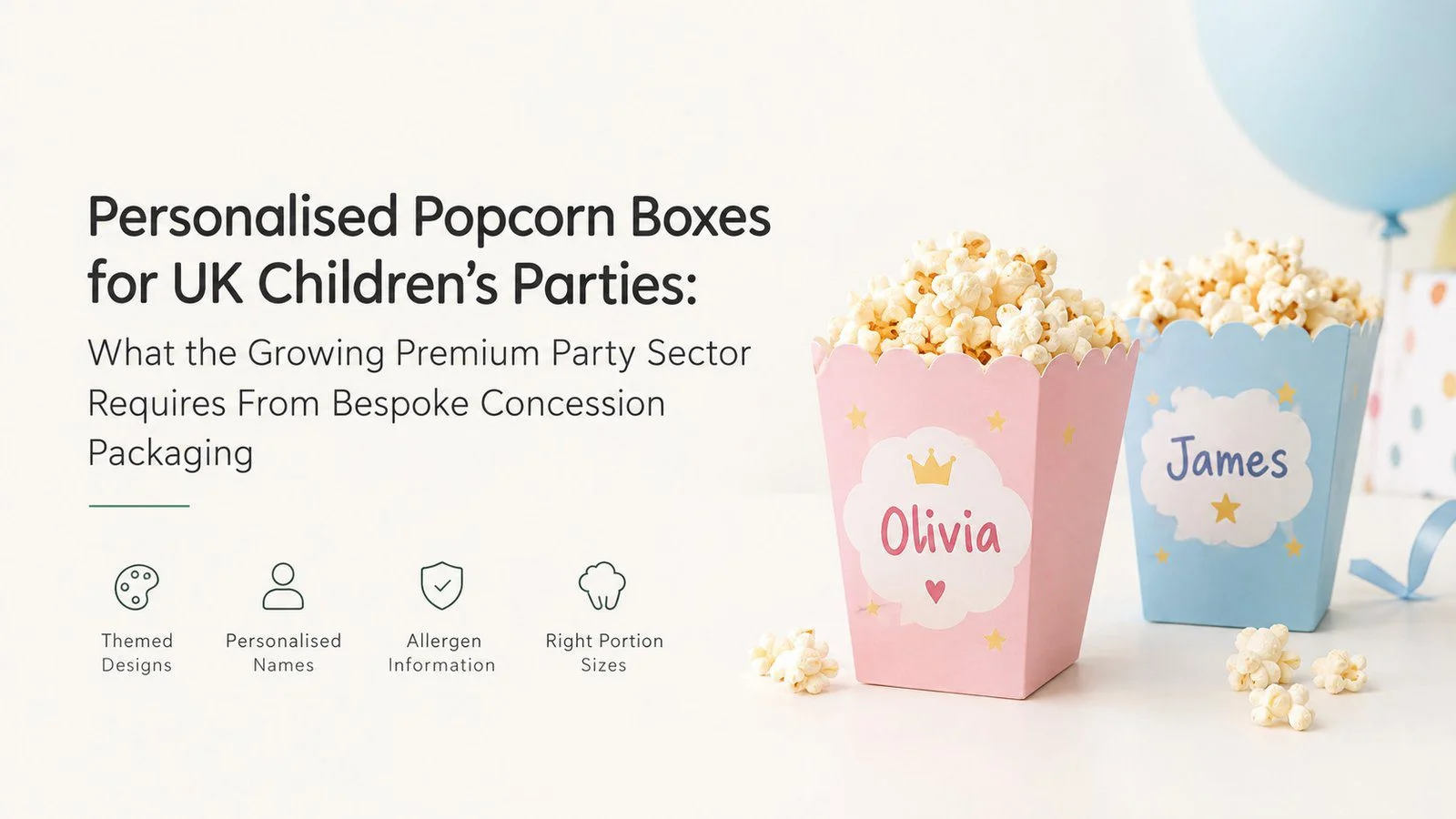
Something has changed in how a meaningful portion of UK parents approach children’s birthday parties, and the change has commercial implications that reach well beyond the event planning industry into the packaging decisions of the suppliers serving it. The shift isn’t universal and it isn’t sudden, but it is consistent enough across London, Manchester, Edinburgh, Bristol and the affluent suburban commuter belt to represent a genuine market development rather than an anecdotal observation. A segment of UK parents who grew up with the pass-the-parcel and supermarket cake standard have moved toward a version of children’s party planning whose investment in experience, visual coherence, and personalised detail sits closer to a small-scale brand activation than to the birthday gatherings of their own childhoods.
In this premium segment, the food and drink presentation at a children’s party is assessed through the same lens as every other visual element of the event. Concession packaging that clashes with the party’s colour palette, carries no personalisation for the birthday child or the guests, and reads as a generic supermarket purchase contradicts the aesthetic investment being made in every other element of the party environment. Personalised popcorn boxes whose colour, typography, and individual name execution are consistent with the rest of the party’s visual identity fill a gap that premium party planning creates but that generic concession packaging can’t fill regardless of how well it performs functionally.
This guide addresses what the growing premium UK children’s party sector actually requires from personalised popcorn boxes, where the specific requirements of child-facing concession packaging add compliance and safety dimensions that adult event packaging doesn’t share, and what suppliers and brands need to understand about this market to serve it at the quality level it expects.
What the Premium UK Children’s Party Market Looks Like
The UK children’s party market has stratified into segments whose packaging requirements differ in commercially significant ways that a single specification can’t serve equally well. The mass market segment, still the largest by volume, uses generic party supplies purchased from Poundland, Asda, and Amazon whose price point and purchasing convenience define the brief. The mid-market segment uses themed party supplies from specialist retailers including Party Pieces, Ginger Ray, and Not On The High Street whose design coherence represents an upgrade from generic without reaching the fully personalised investment of the premium segment. The premium segment commissions party planners, uses professional backdrop and prop hire, engages balloon artists and character entertainers, and sources concession packaging from suppliers whose personalisation capability and design quality matches the professional standard of every other element in the event.
The premium segment’s size as a proportion of the total market is smaller than its commercial significance suggests, because its per-event spending is substantially higher than mass or mid-market events and because its aesthetic standards have a disproportionate influence on aspiration across the market through the social media documentation that premium children’s parties generate. A professionally executed premium children’s birthday party that generates Instagram and TikTok content is influencing the aesthetic expectations of parents who don’t commission premium parties themselves but who form opinions about what good children’s party presentation looks like through exposure to premium event content.
The specific characteristics of the premium UK children’s party market that create packaging requirements beyond standard concession provision are themed visual coherence, individualised guest experience, allergen communication adequacy for children’s dietary needs, portion sizing appropriate for children of different ages, and quality signals that communicate the investment level of the event through every element including the concession packaging. Generic popcorn boxes in generic branding satisfy none of these requirements simultaneously, which is why the premium segment’s growth creates a specific commercial opportunity for personalised popcorn box suppliers whose capability aligns with what this market needs.
What Themed Visual Coherence Requires From Personalised Popcorn Boxes
The visual coherence standard that premium UK children’s party planning applies to every element of the event environment creates specific requirements for personalised popcorn boxes that standard concession packaging development briefs don’t anticipate and can’t accommodate within standard colour, print, and size configurations.
Premium children’s party themes in the current UK market span a range from licensed character themes including popular animation and film properties, through aesthetic themes including under the sea, enchanted forest, and space exploration, to colour palette-led themes whose coherence depends on precise colour consistency across every element including napkins, plates, balloons, backdrop, and concession packaging. The colour precision requirement of palette-led themes is the most demanding because any visible inconsistency between the personalised popcorn box colour and the rest of the palette’s elements reads as a production error in an event context where every visual decision was deliberate.
Achieving the colour precision that palette-led premium party themes require from personalised popcorn boxes means Pantone specification rather than CMYK approximation, which is the same standard that commercial brand packaging applies but that concession packaging for standard events rarely needs. A party planner who has specified every element of a sage green and gold botanical party theme in Pantone references needs popcorn boxes whose sage green and gold match those references under the lighting conditions of the venue rather than under the printing supplier’s standard studio assessment. This specification requirement places personalised children’s party popcorn boxes in the same production quality tier as branded retail packaging rather than in the event supply tier that generic concession packaging occupies.
Licensed character themes add a different dimension to visual coherence that personalised popcorn box suppliers need to understand clearly before accepting briefs from clients who want licensed character imagery on their personalised packaging. Officially licensed character imagery including recognisable Disney, Marvel, Netflix animation, and similar properties is subject to intellectual property rights whose enforcement has become more active rather than less in the UK market. A supplier producing personalised children’s party popcorn boxes with unlicensed use of recognisable character imagery is creating IP infringement liability for themselves and for the client whose event uses the packaging, regardless of how common the practice appears in the party supply market. The correct response to a licensed character brief is either confirmation of licensing status or direction toward original character-inspired design that creates the intended aesthetic without infringing protected IP.
What Individualised Guest Experience Requires From Personalisation Execution
The individualised guest experience that premium children’s party concession packaging creates depends on personalisation execution whose quality at the child-scale viewing distance of the event environment needs to meet a standard that adult event personalisation can approximate more easily because adults have lower expectations of what personalised packaging looks like at a children’s party than the children receiving it do.
A five-year-old who receives a popcorn box with their name on it at a birthday party doesn’t assess the personalisation through the same evaluative framework as an adult receiving a personalised corporate gift. The child’s experience is more immediate and more visceral: the name on the box is their name, which makes the box theirs, which makes the moment of receiving it feel special rather than generic. This direct emotional response to name personalisation is what drives the premium party sector’s investment in individualised concession packaging rather than generic branded packaging shared across all guests.
The personalisation execution quality that creates this emotional response reliably depends on name legibility at the distance and angle from which a child handles the box during the party. A child carrying a popcorn box at arm’s length, looking down at it from a standing position, sees the top panel and front panel at angles that differ from the viewing angles assumed in packaging design presentations conducted on a flat desk surface. Name typography whose size and weight is adequate for an adult’s examination of packaging at desk level may be inadequate for the dynamic viewing conditions of a child handling a box while moving, eating, and interacting with other children simultaneously.
Guest name lists for premium children’s parties create a variable data printing requirement whose accuracy is more commercially critical than adult event personalisation because children whose names are misspelled on party packaging have an immediate and visible reaction that becomes part of the event experience in a way that adults receiving incorrectly personalised materials typically manage more privately. The name data collection and verification process between the party commissioner and the packaging supplier needs to be more explicit and more thoroughly confirmed than equivalent adult event personalisation processes, with written confirmation of every name spelling before production rather than verbal confirmation that introduces transcription error risk.
What Allergen Communication Requires From Children’s Party Popcorn Packaging
The allergen communication requirement on personalised children’s party popcorn boxes adds a compliance dimension that adult event concession packaging shares in principle but that children’s party context makes more commercially and ethically significant because children’s dietary restrictions and allergies are more frequently life-threatening at the severe end and less reliably self-managed at the child end than the equivalent adult population’s dietary requirements.
UK allergen law requires disclosure of the fourteen major allergens wherever food is sold or served in a business context, including catered children’s parties whose food service qualifies as a commercial food service regardless of its private event character. Popcorn whose production involves any of the fourteen allergens, including milk in buttered varieties, gluten in certain flavoured varieties, and tree nuts or peanuts in sweet or savoury flavoured popcorn, must disclose this allergen presence in a manner that is clear and accessible to the person making the food selection decision.
The specific compliance challenge of allergen communication on personalised children’s party popcorn boxes is that the personalisation investment in the front panel creates design pressure to minimise mandatory allergen information whose presence the premium party aesthetic treats as a disruption to the visual coherence that the personalisation investment is creating. A box whose front panel carries a beautifully designed name personalisation and whose back panel carries mandatory allergen information in the minimum legible size satisfies both requirements only if the allergen information is genuinely legible rather than technically present at a size whose reading requires effort that a parent managing a small child at a busy party won’t reliably apply.
The practical allergen communication approach that serves both the premium aesthetic requirement and the compliance requirement places mandatory allergen information in a consistent panel position at a type size genuinely readable by a parent examining the box at arm’s length under party venue lighting, in a layout whose visual treatment is distinct from the personalisation and branding elements rather than integrated with them in a way that reduces its findability. This approach requires allergen communication to be designed into the box specification from the outset rather than added to available space after the personalisation design has been developed, which is why the allergen brief needs to be a starting requirement rather than a subsequent consideration in personalised children’s party popcorn box development.
What Portion Sizing Requires From Personalised Children’s Party Popcorn Box Specifications
The portion sizing requirement that children’s party concession packaging needs to address differs from adult event concession sizing in ways that affect box dimensions, structural specification, and the relationship between box size and the party’s food service plan whose adequacy the concession packaging directly influences.
Children’s appetite for popcorn at a birthday party varies by age in ways that most adult event concession briefs don’t need to accommodate within a single event. A party serving children aged four to seven has different per-child popcorn consumption expectations than a party serving children aged nine to twelve, and a personalised popcorn box sized for adequate portion provision to a nine-year-old provides an over-abundant portion to a four-year-old that creates both food waste and the handling challenge of a box too large for a small child to carry comfortably during the party.
Standard cinema-format small popcorn boxes, which are the most commonly available personalised popcorn box format, produce portions adequate for children aged approximately seven and above but represent portions challenging for younger children to consume completely. Party planners serving younger age groups increasingly specify smaller formats, either the mini popcorn cup format or the boutique favour box format, whose portion is proportionate to younger children’s consumption capacity while maintaining the personalisation and aesthetic quality that the premium party brief requires.
The structural specification of personalised children’s party popcorn boxes needs to account for how children handle boxes during active party environments, which differs from how adults handle concession packaging at seated cinema experiences. A child who receives their personalised popcorn box during an entertainer’s show is handling it while watching, potentially dancing, and interacting with other children in a physical way that adult concession handling doesn’t replicate. Boxes whose structural integrity depends on careful handling develop the base panel separation and side wall deformation that less careful child handling produces more quickly, and personalised popcorn boxes that begin to fail structurally during a premium children’s party create an experience contradiction that the investment in personalisation was designed to prevent.
What UK Party Planners and Commissioners Need From a Personalised Popcorn Box Supplier
The supplier relationship that produces personalised children’s party popcorn boxes meeting premium UK party sector standards requires capabilities and service commitments whose presence or absence determines whether the supplier can serve this market at the quality level it requires.
Minimum order flexibility matters for children’s party applications because party guest lists are finite and small in ways that standard event concession ordering doesn’t accommodate efficiently. A premium children’s birthday party serving twenty to thirty guests needs twenty to thirty personalised boxes with individual names, a quantity whose production requires a supplier whose minimum order quantities at personalised production work economically for the buyer rather than requiring purchase of multiples of the required quantity to reach a minimum that standard event supply economics produces. Low-quantity variable data digital printing that produces each individual name at commercially viable per-unit costs for runs of twenty to fifty units is the production capability that children’s party personalisation requires.
Lead time reliability within the compressed planning cycles of children’s party organisation is a supplier service requirement that the premium party sector’s planning culture creates. Parents and party planners who confirm catering and entertainment several months in advance may confirm personalised concession packaging weeks rather than months before the event, and the production and delivery timeline that a supplier can guarantee within this compressed window determines whether they can serve the premium party market’s planning realities rather than only the more extended lead time assumptions of commercial event supply.
Design support capability whose standard extends to interpreting a party planner’s visual brief and producing personalised popcorn box artwork whose colour, typography, and layout align with the party’s wider aesthetic rather than defaulting to the supplier’s standard personalisation template is the design service quality that premium children’s party sector buyers assess explicitly when selecting a personalised popcorn box supplier. A supplier whose personalisation is limited to name text in a fixed position on a standard box template serves the personalisation requirement without serving the visual coherence requirement that premium party planning applies to every commissioned element of the event.
Aly Packaging UK works with party planners and parents commissioning personalised popcorn boxes for premium children’s party events, including variable name personalisation, allergen-compliant panel design, and colour specifications matched to party themes. Contact our UK team at sales@alypackaging.com or call 1-844-259-7225 to discuss your event’s personalised packaging requirements.


